
Polyvinyl Chloride (PVC) Panels Explained: The Modern, Low-Maintenance Wall Cladding Solution
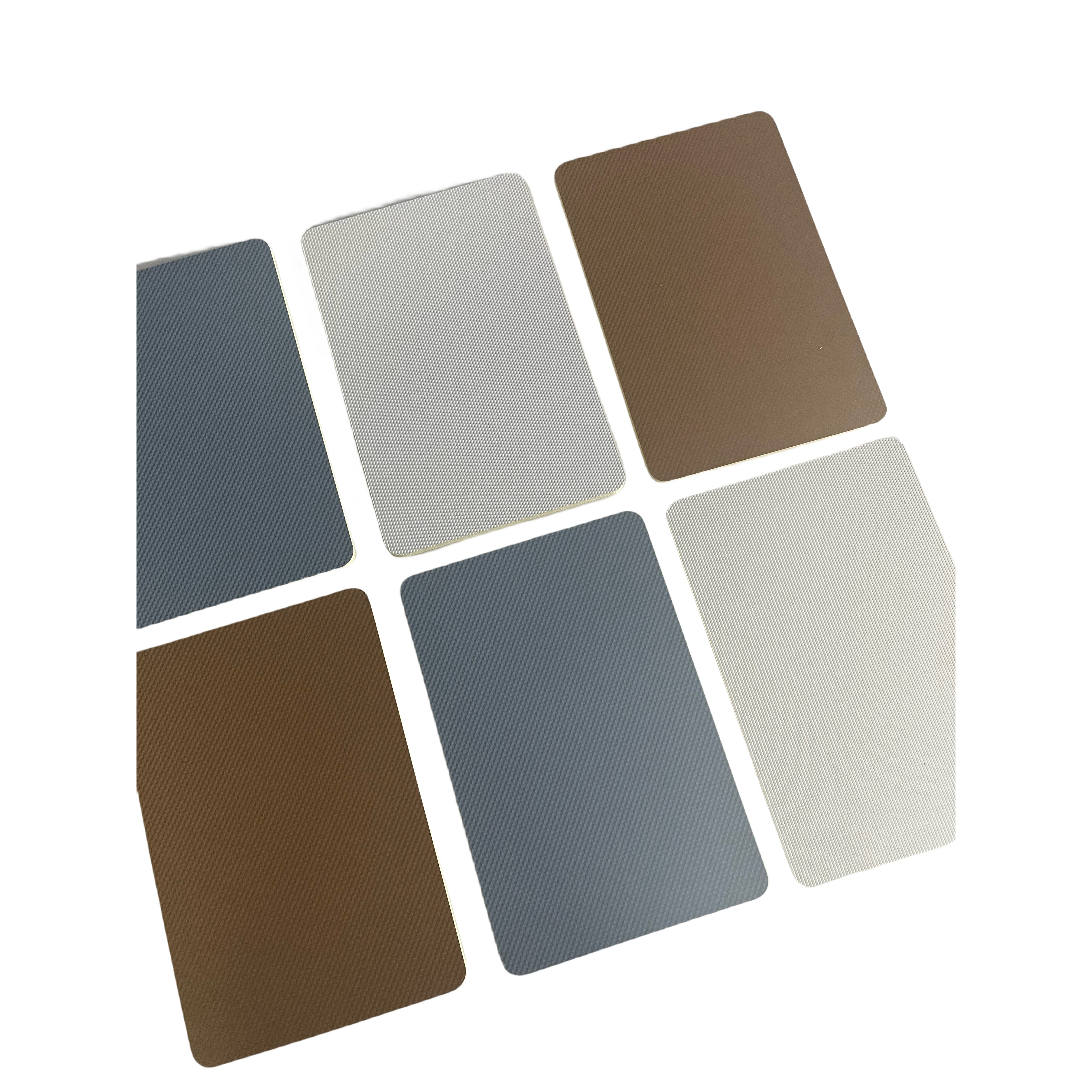
Polyvinyl chloride (PVC) panels are rigid decorative sheets made from PVC resin, calcium carbonate, and processing additives, installed as wall and ceiling cladding in residential, commercial, and hospitality interiors. Their practical identity rests on four properties that traditional cladding materials rarely combine: low weight, waterproof performance, termite resistance, and fast mechanical installation.
The category is no longer simply a low-cost substitute for tile. Dataintelo valued the global PVC panels market at USD 14.8 billion in 2025, and PVC wall panels alone accounted for a 42.5% share by product type. For construction distributors, that means PVC panel is a repeat-purchase line sitting directly against gypsum board, ceramic tile, painted plaster, and wood-based decorative panels.
This guide explains what PVC panels are made of, why they are considered low-maintenance, how the main product families differ, how each type is installed, and what distributors should verify before committing to a long-term supply program.
What PVC Panels Are Actually Made Of
The base formulation is short: PVC resin, calcium carbonate, and additives. Resin forms the continuous matrix that gives the sheet its strength and waterproof surface, calcium carbonate works as a mineral filler that adds body and dimensional stability, and additives cover stabilizers, lubricants, and pigments. YIKE NEW MATERIAL specifies this same composition across its PVC ceiling panel, PVC wall panel, and PVC marble sheet ranges.
Because the formulation is adjustable, two panels of identical size can behave differently. YIKE PVC ceiling panels are produced with PVC content between 35% and 50% and thicknesses from 6 mm to 10 mm, and the stated PVC content is a product specification rather than a marketing detail. In rigid PVC compounds used for building panels, manufacturers commonly reference ASTM D1784 Cell Class 12454, the classification associated with favorable impact and tensile strength. Buyers comparing quotations should compare declared formulation and cell classification, not only price per square meter.
Two material families sit under the PVC panel umbrella:
- Rigid PVC panels — PVC resin plus calcium carbonate, used for ceiling panels, wall panels, decorative panels, marble sheets, and self-adhesive wall stickers.
- WPC (wood plastic composite) panels — a PVC/PE matrix combined with wood fiber and additives for interior fluted wall panels, or wood fiber plus HDPE and additives for co-extruded and traditional outdoor wall panels.
The distinction is commercial as well as technical. Rigid PVC panels are the volume, price-driven lines, while indoor and outdoor WPC panels carry higher unit value because of their density, impact resistance, and weather exposure requirements.
The Maintenance Problem PVC Panels Were Built to Solve
Traditional decorative wall and ceiling materials usually fail on maintenance rather than on appearance. Wood veneer and MDF decorative panels need repainting and anti-mold treatment once moisture reaches the substrate. Gypsum and wooden ceilings stain, sag, and need refinishing where humidity or cooking fumes are constant. Natural marble and ceramic tile require polishing, sealing, and grout care, and their weight adds structural load.
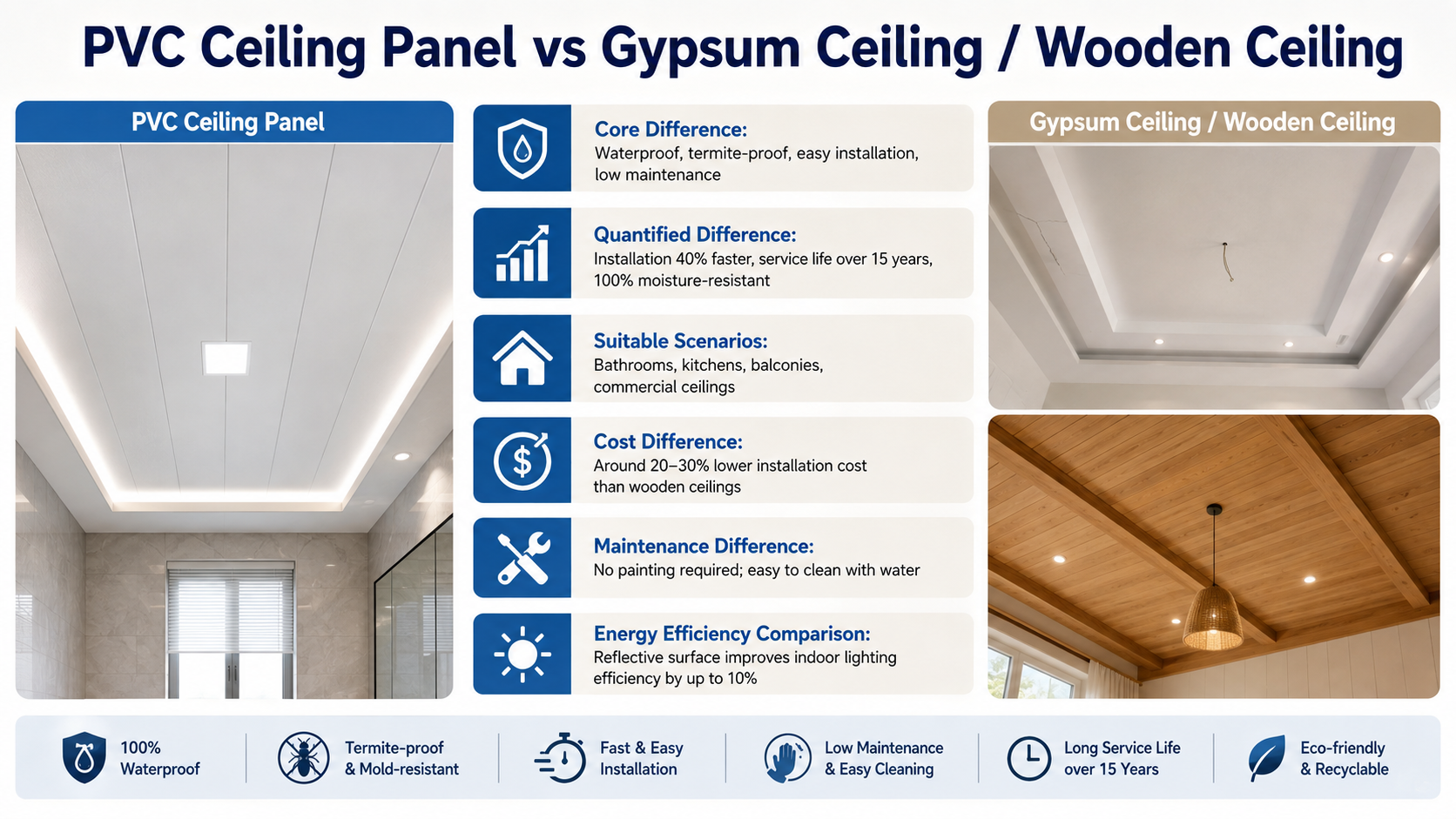
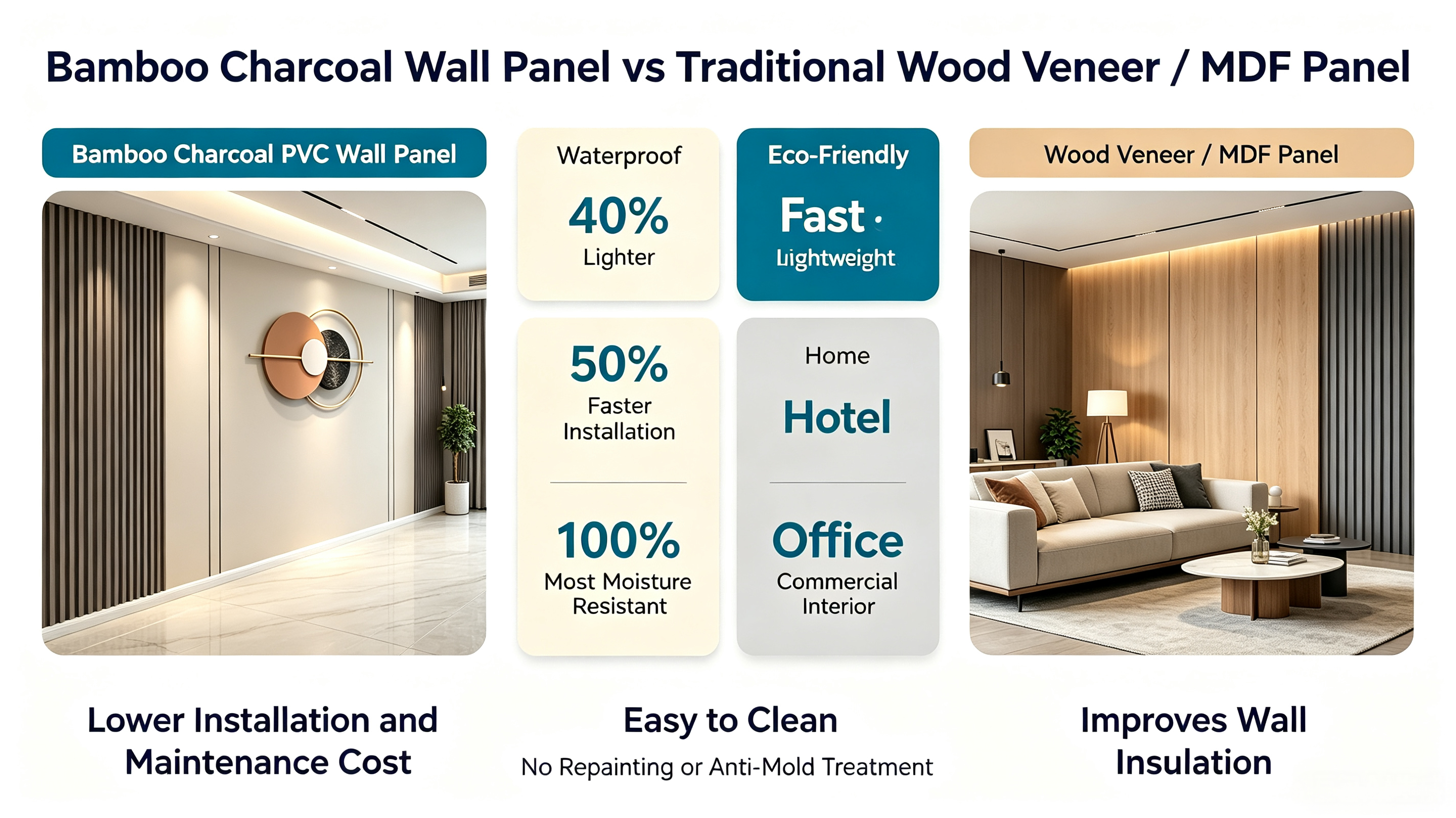
PVC-based panels are engineered against those specific failure modes. Compared with traditional wood veneer and MDF decorative panels, PVC wall panels are approximately 40% lighter, install 50% faster, and deliver 100% moisture resistance with no repainting or anti-mold treatment required. PVC ceiling panels are 100% moisture-resistant and termite-proof, with a service life of over 15 years and no painting required. PVC marble sheets need no polishing, sealing, or repainting, and are waterproof, stain-resistant, and easy to clean.
Why this matters to a distributor: a lower-maintenance cladding line reduces callbacks, replacement claims, and installation labor — the costs that decide whether a category stays profitable after the first container.
Where the Category Stands in the 2025 Building Materials Market
Several independently published datasets describe the same direction of travel:
- The global PVC panels market reached USD 14.8 billion in 2025, with PVC wall panels holding a 42.5% share by product type and Asia-Pacific accounting for a 38.4% revenue share (Dataintelo).
- The global wood plastic composite (WPC) market is estimated at USD 8.97 billion in 2025 (SNS Insider).
- Synthetic marble, including PVC marble sheets, is projected to grow at a CAGR of 6.8% from 2025 to 2032 (Metastat Insights).
- The global ceiling tiles market, which includes PVC ceiling products, was projected at USD 8.03 billion in 2024, growing at a CAGR of 10.2% (Cognitive Market Insights).
- The global peel-and-stick self-adhesive wallpaper market was valued at USD 3.8 billion in 2025, with vinyl segments holding a 48.6% share (Dataintelo).
- China's total PVC exports reached approximately 3.82 million tonnes in 2025, a 46% increase from 2024, with India taking about 39% of that volume (General Administration of Customs of the PRC, reported by OilChem).
Supply-side concentration is part of the picture. Dataintelo identifies Palram Industries Ltd. and Dumaplast NV among the global competitors in the PVC panels sector, while Chinese manufacturers dominate export volume, particularly in wall-panel and ceiling-panel formats.
Read market-size numbers carefully. Published estimates vary by scope: Dataintelo puts total PVC panels at USD 14.8 billion in 2025, while Metastat Insights estimates the narrower PVC wall panel segment at USD 5.84 billion. The gap is definitional, depending on whether flooring and exterior systems are counted. When a report is used for planning, the scope definition matters more than the headline figure.
The Core Value Proposition: Lightweight, Waterproof, Low-Maintenance
Weight and handling
PVC wall panels are roughly 40% lighter than traditional wood veneer or MDF decorative panels, and PVC marble sheets are up to 70% lighter than natural marble. Lighter panels reduce freight weight, allow single-person handling on site, and lower the load carried by partitions and ceilings.
Water and moisture performance
PVC marble sheets and a large part of the PVC wall panel range are specified as 100% waterproof. Moisture resistance is rated at 100% for PVC wall panels against wood veneer and MDF, and PVC ceiling panels do not absorb water, so they do not swell, mildew, or deform in humid interiors. This is why the category is specified for bathrooms, kitchens, balconies, and other high-humidity rooms, although continuous water immersion should still be avoided.
Termite and rot resistance
PVC ceiling panels are termite-proof and WPC wall panels are termite-resistant, and neither requires anti-termite treatment. With no cellulose substrate to feed on, termite risk — a recurring maintenance cost in tropical and subtropical markets — is removed from the wall assembly.
Installation speed
Verified comparisons show consistent labor savings: 50% faster installation than wood veneer or MDF panels, 40% faster than gypsum or wooden ceilings, 30% faster for WPC wall panels against solid wood, and up to 70% faster for self-adhesive wall stickers, which can complete a renovation in one day. Ceiling installation cost is around 20–30% lower than wooden ceilings.
Day-to-day maintenance
Surfaces are smooth and stain-resistant. Routine cleaning is a dry or damp soft cloth; for stubborn marks, diluted neutral detergent is sufficient, and corrosive chemicals should be avoided. There is no repainting, polishing, sealing, or anti-mold cycle to schedule.
Environmental profile
Qualified PVC panels are produced from eco-friendly raw materials and are formulated to be free of formaldehyde and harmful volatile substances, meeting national and international environmental safety standards. They are non-toxic and odorless, which is why the category is used in homes, hospitals, and schools.
Service life expectations
- PVC ceiling panels: over 15 years
- PVC marble sheets: over 15 years
- Interior WPC wall panels: over 20 years
- Outdoor WPC wall panels: 15–25 years (product datasheet range)
- PVC self-adhesive wall stickers: 5–10 years indoors
Where the value proposition stops
The limits matter as much as the benefits. PVC marble sheets are indoor decorative panels, and long-term UV exposure outdoors causes surface fading and aging. Indoor WPC panels are not a substitute for outdoor WPC panels on façades, since outdoor grades use UV-stabilized, weather-resistant formulations and require expansion gaps during installation. Self-adhesive wall stickers are not recommended for continuous water-contact shower zones, because long-term immersion causes edge warping and peeling. A qualified ceiling panel is also preferable to an unqualified one: fire-retardant indicators should be inspected before delivery.
The YIKE NEW MATERIAL PVC Panel Range, Explained
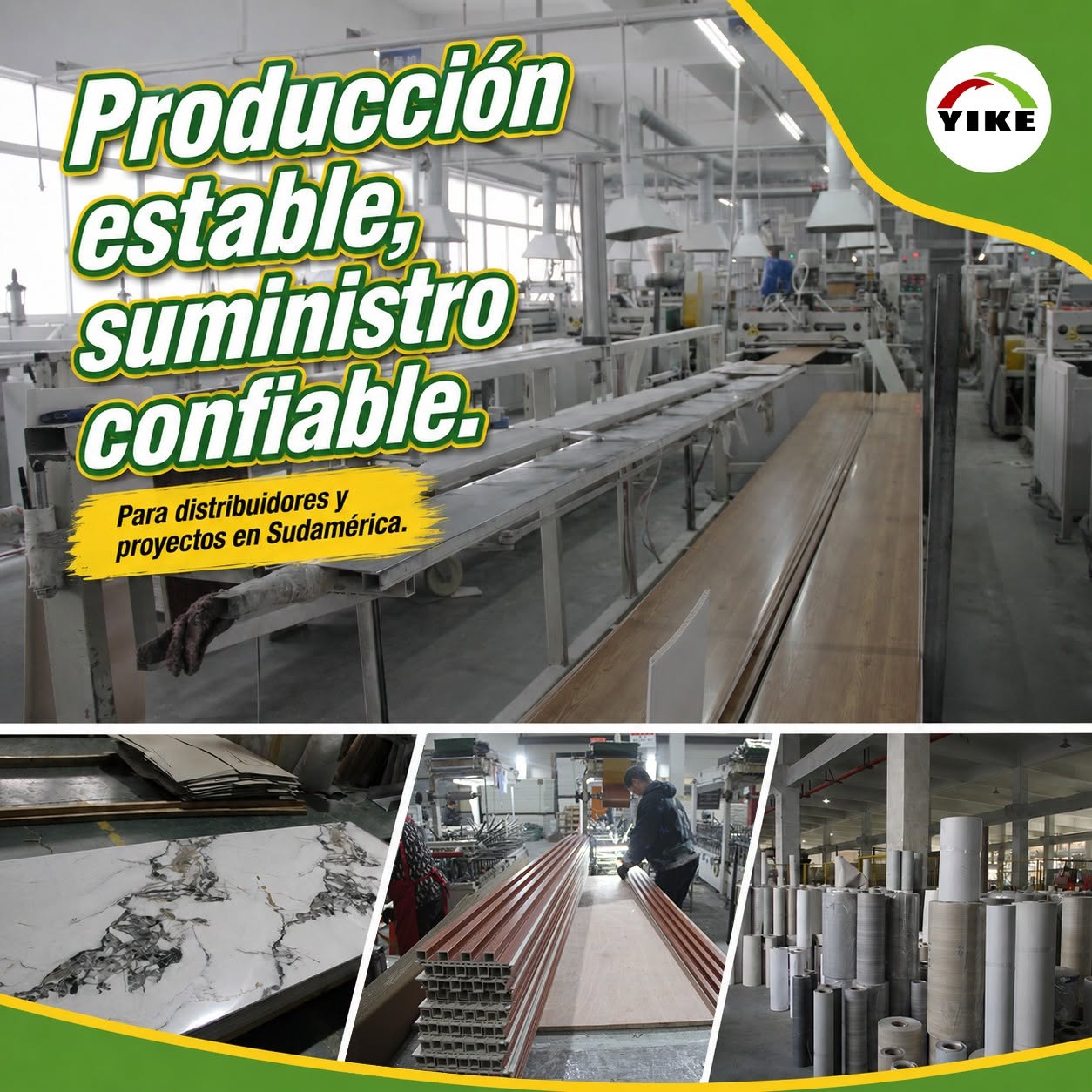
YIKE NEW MATERIAL (HAINING YIKE NEW MATERIAL CO., LTD) is a China-based manufacturer and exporter of PVC and WPC decorative building materials, founded in 2019. The company operates a 10,000 m² factory in Haining, Jiaxing, Zhejiang Province, with 50 employees, a 10-engineer R&D team, and an annual output of 5,000,000 m². It exports 100% of its production to Central America, South America, Southeast Asia, the Middle East, and Africa, including markets such as Honduras, Nicaragua, Guatemala, Colombia, Ecuador, Peru, and the Philippines.
1. PVC Ceiling Panel
Waterproof, moisture-proof ceiling panels offered in widths of 200, 250, 300, 400, and 600 mm; lengths of 2900, 2950, 3950, 5800, and 5950 mm or customized; and thicknesses of 6, 7, 7.5, 8, 9, and 10 mm. PVC content ranges from 35% to 50%. Surface finishes include printing, hot stamping, and lamination, with PE film or carton packaging. Some models reach B1 flame retardant grade. The modular snap-on design is simple to install and does not require complicated construction processes.
2. PVC Wall Panel
Standard size 1220 × 2440 mm with 1220 × 2800 mm options, in 5 mm and 8 mm thicknesses. Patterns cover marble, wood grain, fabric, stone, and metal, and panels are installed with glue, aluminum profile, or hidden fixing. Large-size PVC wall panels offer high flatness, fewer splicing seams, and good sound insulation, with partial models reaching B1 flame retardant grade.
3. PVC Marble Sheet and UV Marble Sheet
Lightweight decorative wall panels in 1220 × 2440 mm and 1220 × 2800 mm formats, with thicknesses of 2.0, 2.2, 2.5, 2.8, and 3.0 mm and high-gloss, matte, or embossed UV-coated surfaces. Patterns include marble, wood, and golden designs, and the panels are 100% waterproof with glue, silicone, or aluminum-profile installation. Against natural marble, the verified performance gap is up to 70% lighter weight, 40–60% faster installation, up to 60% lower material cost, and a service life of over 15 years.
4. WPC Wall Panel and WPC Fluted Wall Panel
Interior wood plastic composite panels in models such as 160*20*2900 mm, 160*24*2900 mm, 150*10*2900 mm, 168*24*2900 mm, 150*15*2900 mm, and 200*20*2900 mm, in walnut, oak, teak, black, grey, and natural wood finishes, or customized colors. Installation is by clip, screw fixing, or glue. The composite structure delivers higher density and stronger impact resistance than ordinary PVC panels, with better moisture-proof and anti-mildew performance, making the range suitable for basements, hotel bathrooms, and other high-humidity interiors.
5. Outdoor WPC Wall Panel
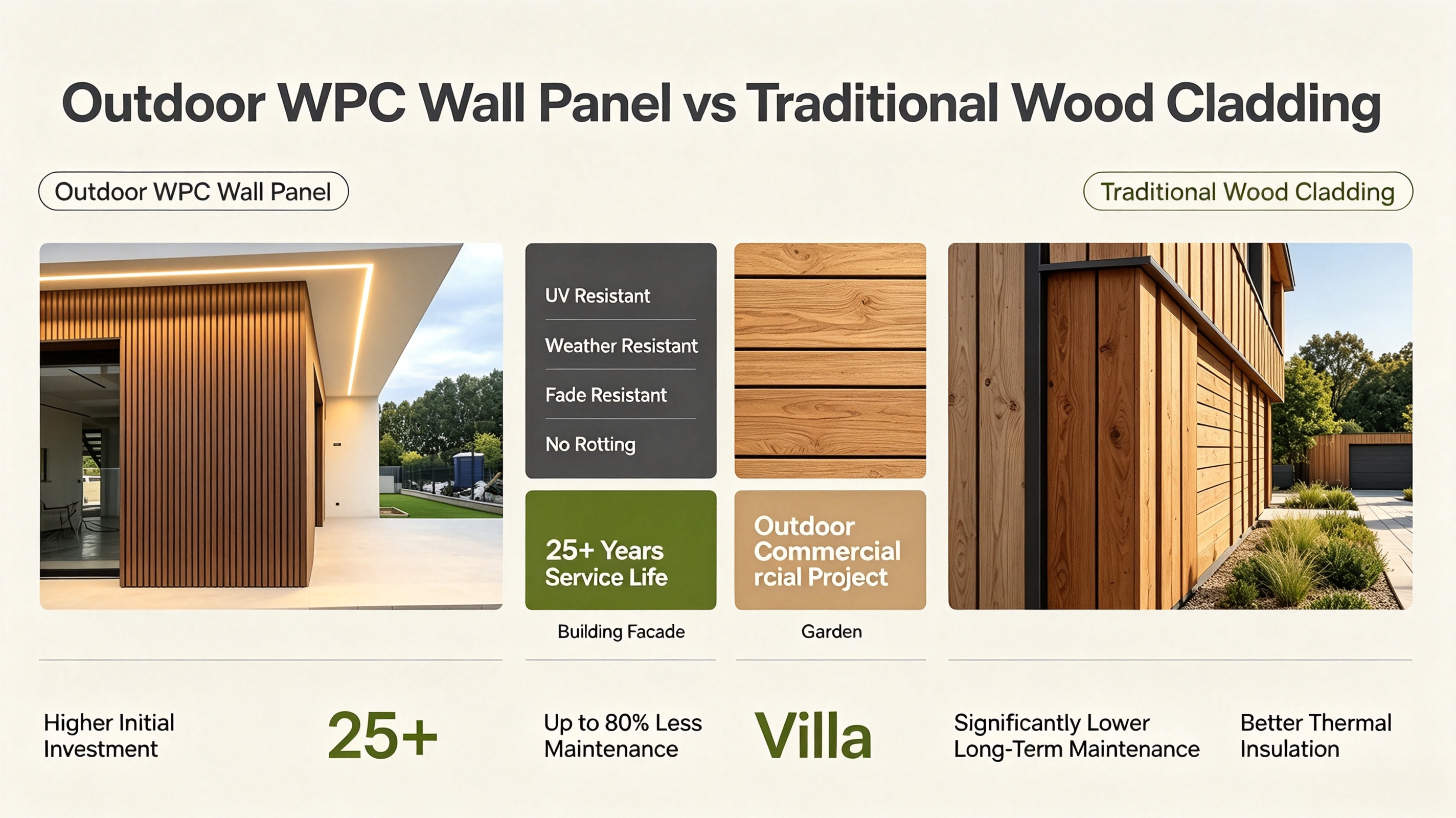
Exterior panels made from wood fiber, HDPE, and additives, supplied in co-extruded or traditional WPC construction, with widths of 140, 145, 177, and 219 mm, thicknesses of 13, 20, and 26 mm, and a standard 2.9 m length or customized dimensions. Colors include chocolate, brownish red, orange, black, light grey, green, original wood, and dark grey. Verified comparison data positions outdoor WPC against traditional wood cladding with a service life of over 25 years and maintenance reduced by up to 80%, while YIKE datasheets state a 15–25 year service life depending on grade and exposure conditions.
6. PVC Self-Adhesive Wall Sticker
A quick-install decorative option at 2.5 mm thickness, in 600 mm and 1200 mm widths and 3 m roll length, available in models YK-1200*3000mm and YK 600*3000mm. Surface finishes are glossy, matte, and embossed, with marble, wood grain, stone, concrete, brick, tile, solid color, and floral patterns. Indoor service life is 5–10 years, and installation is up to 70% faster than wallpaper or ceramic tiles, with material and installation costs up to 50% lower than ceramic tiles.
7. PVC Decorative Panel
Interior decorative formats that share the rigid PVC core and are used for feature walls and coordinated interior schemes alongside the wall panel range.
How PVC Panels Are Installed: Step by Step
PVC ceiling panels
- Measure the ceiling area and mark mounting lines.
- Install the supporting keel framework horizontally.
- Cut PVC panels to the required size.
- Insert panels into the interlock groove and fix with nails or screws.
- Install end trims and check overall flatness.
Wear protective gloves and safety goggles while cutting, keep good ventilation, and use stable scaffolding or ladders for overhead work.
PVC wall panels
- Clean and level the base wall surface.
- Measure dimensions and cut panels to size.
- Install keels or apply adhesive evenly.
- Splice panels tightly and fix them firmly.
- Install decorative trims and inspect overall flatness.
Use dust masks and protective goggles during cutting, and keep adequate ventilation during cutting and glue work.
PVC marble sheets
- Clean and level the base wall surface.
- Measure and cut sheets to the required size.
- Apply environmental adhesive evenly on the back of the panels.
- Paste sheets onto the wall and adjust flatness.
- Fill joints and polish the surface.
Indoor and outdoor WPC wall panels
- Clean and level the base wall; for exterior use, treat the base to ensure good drainage.
- Measure dimensions and cut panels.
- Install keels (corrosion-resistant metal keels outdoors) or an adhesive base, reserving expansion gaps for exterior work.
- Assemble panels by interlocking and fix firmly with clips, screws, or dedicated stainless-steel fasteners.
- Fit finishing trims and check assembly tightness and drainage.
PVC self-adhesive wall stickers
- Clean and dry the wall surface thoroughly.
- Measure the area and cut the sticker to the required size.
- Slowly peel off the backing release paper.
- Paste from top to bottom and squeeze out air bubbles.
- Trim the edges and check the overall sticking effect.
Work in a well-ventilated space and avoid applying stickers on damp, peeling, or dusty walls.
Where PVC Panels Perform Best: Use Cases
- Residential interiors — kitchens, bathrooms, balconies, living rooms, and feature walls, where waterproof and easy-clean surfaces matter most.
- Hospitality projects — hotel corridors, guest rooms, and wet areas, using PVC wall panels, marble sheets, and ceiling panels together.
- Commercial fit-out — offices, supermarkets, shopping malls, and corridors, where installation speed and low maintenance reduce downtime.
- High-humidity and public spaces — hospitals, schools, basements, and laundry areas, where anti-mildew performance and formaldehyde-free materials are a selection criterion.
- Rental and refurbishment work — self-adhesive wall stickers and marble sheets for one-day renovation upgrades where individual pieces can be replaced without damaging the wall.
- Exterior and landscape projects — building façades, villas, gardens, and outdoor commercial façades, using outdoor WPC wall panels with UV-resistant formulations.
PVC Panels vs Traditional Cladding: Comparison Table
| Comparison | Verified performance gap | Best-fit applications | Cost and maintenance position |
|---|---|---|---|
| PVC wall panel vs traditional wood veneer / MDF decorative panel | About 40% lighter; installation 50% faster; 100% moisture resistance | Homes, hotels, offices, commercial interiors | Lower installation and maintenance costs; no repainting or anti-mold treatment required |
| PVC ceiling panel vs gypsum ceiling / wooden ceiling | Installation 40% faster; service life over 15 years; 100% moisture-resistant; reflective surface improves indoor lighting efficiency by up to 10% | Bathrooms, kitchens, balconies, commercial ceilings | Around 20–30% lower installation cost than wooden ceilings; no painting required and easy cleaning with water |
| PVC marble sheet vs natural marble / ceramic tile / latex paint wall / ordinary plastic wall panel | Up to 70% lighter; 40–60% faster installation; service life over 15 years | Hotels, apartments, villas, offices, shopping malls, hospitals, schools | Up to 60% lower material cost than natural marble, plus lower transport and installation cost; no polishing, sealing, or repainting |
| WPC wall panel vs solid wood wall panel | Installation 30% faster; service life over 20 years | Living rooms, offices, hotels, retail spaces | Maintenance cost reduced by over 60%; no repainting or anti-termite treatment |
| Outdoor WPC wall panel vs traditional wood cladding | Service life over 25 years; maintenance reduced by up to 80% | Building façades, villas, gardens, outdoor commercial projects | Higher initial investment but significantly lower long-term maintenance cost; no painting, sealing, or frequent repairs |
| PVC self-adhesive wall sticker vs wallpaper / ceramic wall tiles | Installation up to 70% faster; renovation completed in one day | Rental apartments, kitchens, bathrooms, DIY home decoration | Material and installation costs up to 50% lower than ceramic tiles; individual pieces can be replaced without damaging the wall |
What Distributors Should Verify Before a Long-Term Supply Commitment
A one-off container can be judged on price. A distribution line cannot. YIKE exports its full output to overseas markets and works with importers, wholesalers, contractors, and building material retailers, so the seasonal checks below are the ones that protect a repeat-purchase relationship.
- Formulation and density, not just price. Confirm declared PVC content, thickness, and cell classification. Board density and sheet flatness determine how a panel behaves on site in humid or high-traffic interiors.
- Surface and film performance. Check surface adhesion, anti-yellowing performance, and environmental level. For marble sheets, verify UV or high-gloss coating durability and anti-scratch behavior under normal handling.
- Product-specific criteria. Adhesive strength, residue-free removal, and printing clarity for self-adhesive wall stickers; anti-UV and weather resistance for outdoor WPC; anti-deformation and surface co-extrusion layer for indoor WPC.
- Fire and moisture documentation. Relevant standards include ASTM E84 (UL 723) Class A for interior wall and ceiling finishes in North America, EN 13501-1 for EU reaction-to-fire classification, ASTM D570 / ISO 62 for water absorption, and ISO 105-B02 for color fastness to artificial light.
- Batch consistency. Color difference between production batches is one of the most common complaints in decorative panel categories. Unified raw material formulation and batch color calibration are the practical countermeasures.
- Installation support and replacement. Installation guidance and individual panel replacement reduce claims in the field, where a distributor's reputation is actually built.
Frequently Asked Questions
Do PVC panels meet fire and safety standards for commercial interiors?
Compliance is product-specific rather than category-wide. In North America, ASTM E84 (UL 723) is the primary fire test standard for interior wall and ceiling finishes, and a Class A rating requires a Flame Spread Index of 0–25. In the EU, EN 13501-1 classifies reaction to fire, and PVC panels for commercial use commonly target Class B-s1, d0. YIKE PVC wall panels include partial models that reach B1 flame retardant grade, and fire-retardant indicators are inspected before delivery. Because ratings differ by model, buyers should request documentation for the exact panel rather than assume a category-level rating. Moisture and color performance can be verified against ASTM D570 / ISO 62 (water absorption) and ISO 105-B02 (color fastness to artificial light).
What actually makes PVC panels resistant to moisture, termites, and everyday wear?
The panel body is a closed PVC-based compound rather than a cellulose material, so there is nothing for termites to feed on and no fiber structure to absorb water. YIKE PVC ceiling panels are specified as waterproof and moisture-proof: they do not absorb water and are not prone to mildew or deformation. PVC wall panels deliver 100% moisture resistance compared with wood veneer and MDF, and require no repainting or anti-mold treatment. WPC wall panels are termite-resistant and need no anti-termite treatment. Everyday wear is handled by smooth, stain-resistant surfaces that clean with a damp cloth and diluted neutral detergent. The main boundary conditions are UV exposure, since indoor panels fade under long-term outdoor sunlight, and continuous water immersion, which is why self-adhesive stickers are not recommended in shower zones with constant water contact.
How do PVC panels compare on cost with traditional materials?
The comparison is structural rather than a single list price. PVC ceiling installation cost runs around 20–30% lower than wooden ceilings. PVC marble sheets cost up to 60% less in material than natural marble, with additional savings in transportation and installation. Self-adhesive wall stickers cost up to 50% less than ceramic tiles across materials and installation. Outdoor WPC wall panels require a higher initial investment than traditional wood cladding but cut maintenance by up to 80%, which shifts the total cost in their favor over the life of a façade. WPC wall panels reduce maintenance cost by over 60% against solid wood. Actual landed cost still depends on specification, quantity, packing, and freight terms, which is why a project-specific quotation is more useful than a category average.
Can I validate samples before placing a bulk order?
Yes, and sampling is the standard practice for both one-time project orders and long-term wholesale import business. Buyers should confirm sheet density, flatness, surface film bonding strength, anti-yellowing performance, and environmental level on the sample, plus product-specific points such as adhesive viscosity, backing release paper quality, and printing clarity for self-adhesive wall stickers, or UV and weather resistance for outdoor WPC. Pre-shipment testing is the acceptance criterion applied before delivery, and suppliers can provide pre-production samples and relevant test reports so that mass-order quality is compared against a validated reference rather than a brochure image.
What does a long-term PVC panel supply program look like for construction distributors?
For a distributor building a durable cladding category, the commercial framework matters as much as the product. The minimum order quantity is one 20-foot container with 4–6 colors from the E-catalog; smaller quantities can be arranged with 500 sqm per color from stock colors, or 1000 sqm from the E-catalog. Delivery terms are FOB, CIF, or CFR, and payment terms are 30% T/T in advance with 70% against a copy of the B/L, with pre-shipment testing as the acceptance criterion. Combined with a 10,000 m² factory, an annual output of 5,000,000 m², and 100% export experience across Central America, South America, Southeast Asia, the Middle East, and Africa, this structure supports repeat programs rather than one-off purchases. To review specifications or request samples, contact YIKE NEW MATERIAL at sales@merchandise-eco.com or +86 188-5830-7787.
Conclusion
PVC panels are best understood as a maintenance decision rather than a decorative trend. The core formulation of PVC resin, calcium carbonate, and additives produces a lightweight, waterproof, termite-proof sheet that installs faster than wood veneer, MDF, gypsum, or tile, and needs no repainting, polishing, sealing, or anti-termite treatment afterward. Verified comparisons quantify the gap: 40% lighter and 50% faster to install than wood veneer and MDF, 40% faster than gypsum and wooden ceilings, 30% faster than solid wood for WPC, and up to 70% faster for self-adhesive wall stickers.
With the PVC panels market valued at USD 14.8 billion in 2025 and PVC wall panels holding a 42.5% product-type share, the category is large enough to anchor a distributor's interior wall and ceiling portfolio. Matching the right product family to the right zone — rigid PVC for ceilings and decorative walls, marble sheets for high-visibility interiors, WPC for high-humidity and exterior surfaces, self-adhesive stickers for fast refurbishment — is what converts the category from a price line into a repeat business.
Request PVC Panel Samples and Specifications
YIKE NEW MATERIAL supplies PVC ceiling panels, PVC wall panels, PVC marble sheets, UV marble sheets, WPC wall panels, WPC fluted wall panels, outdoor WPC wall panels, PVC decorative panels, and PVC self-adhesive wall stickers to importers, wholesalers, contractors, and building material retailers worldwide.
Email: sales@merchandise-eco.com | Tel / WhatsApp: +86 188-5830-7787 | Contact: James Cao
Address: Room 1315, NO. 273 Haining Avenue, Haizhou Street, Haining, Jiaxing City, Zhejiang Province, China
Website: www.merchandise-eco.com
Download the full product catalog: YIKE New Material Product Catalog (PDF)

Have Questions or Need More Details?
Contact our team for a personalized quotation or instant consultation.
Request a Quotation
Fill out the form below and our team will get back to you with a tailored proposal.
WhatsApp Direct Chat
Prefer to chat in real-time? Message us on WhatsApp for instant assistance & quick answers.
- Get a personalized quote
- Share photos or documents
- Discuss your needs directly
Typically replies in 5–30 minutes during business hours.