
PVC & WPC Wall Panel Compliance Guide: Matching Product Types to Regional Standards
PVC & WPC Wall Panel Compliance Guide: Matching Product Types to Regional Standards
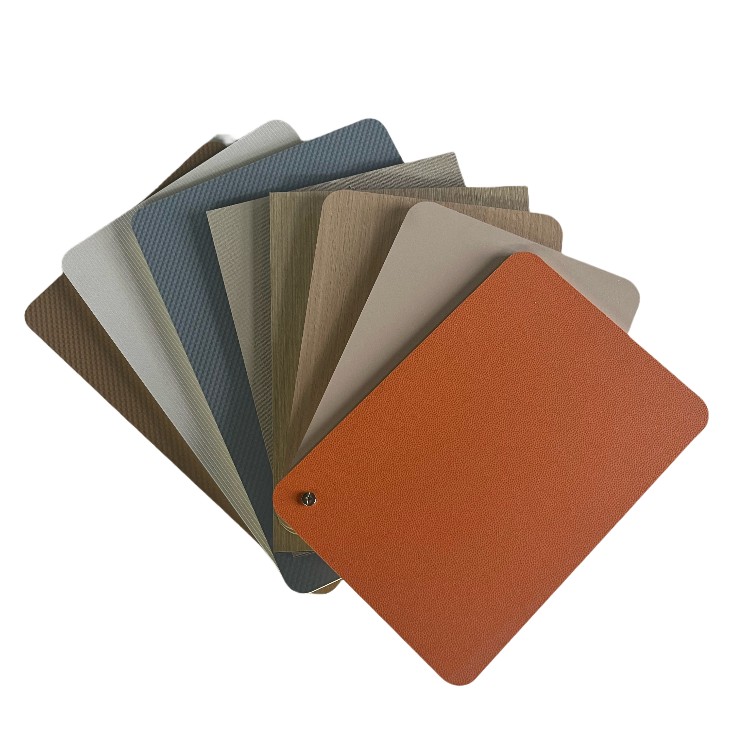
A 1220 × 2440 mm UV-coated PVC marble sheet, a 200 mm wide PVC ceiling panel and a 219 × 26 mm co-extruded outdoor WPC profile can ship in one container and still answer three completely different compliance questions. Most documentation problems in this category do not start with a missing certificate. They start with a document that was issued for a different construction, a different thickness or a different application zone than the SKU actually being imported.
This guide maps six product lines — PVC wall panel, PVC self-adhesive wall sticker, outdoor WPC wall panel, WPC wall panel, PVC marble sheet and PVC ceiling panel — to the regional compliance questions importers most often have to answer. It also explains how to request standards and certification documentation for PVC resin and calcium carbonate panels, UV-coated marble sheets, co-extruded WPC profiles and self-adhesive PVC rolls, and how to verify factory claims, OEM/ODM capability and application suitability before an order is placed.
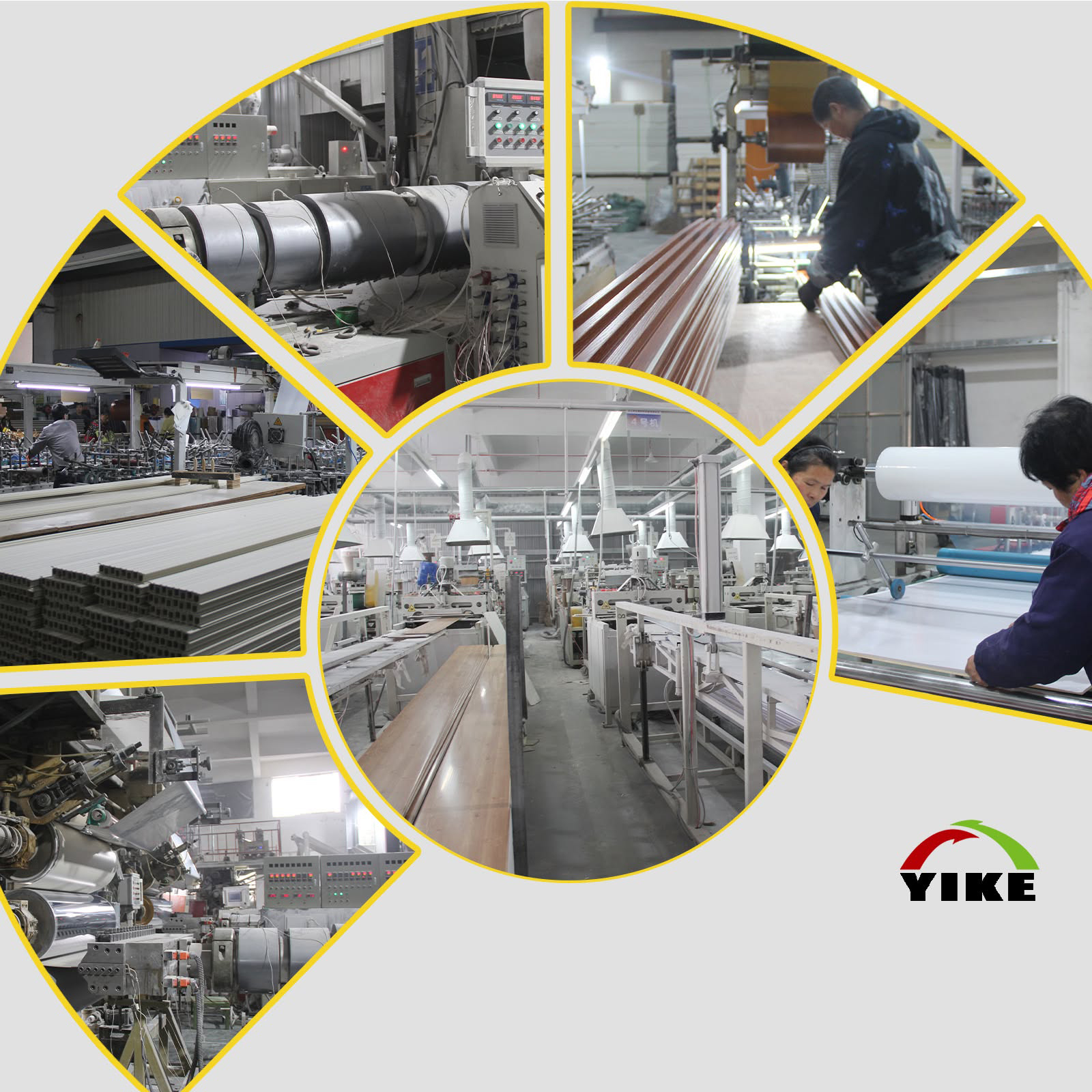
YIKE NEW MATERIAL (Haining Yike New Material Co., Ltd.) is a China-based manufacturer and exporter of PVC and WPC decorative building materials, founded in 2019 in Haining, Jiaxing City, Zhejiang Province. The company operates a 10,000 m² factory, exports 100% of its output to Central America, South America, Southeast Asia, the Middle East and Africa, and publishes product information through merchandise-eco.com and blog.merchandise-eco.com. Its range covers the six product lines discussed below.
Why “Is Your Panel Certified?” Is the Wrong First Question
Decorative panel compliance is a three-variable problem: the product construction, the application zone, and the destination market. A compliance answer is only valid when all three are defined. When a buyer asks a supplier whether their panel is “certified” without those three variables, the supplier will usually send the document that is easiest to send — not the document that answers the question.
Failure mode 1 — construction mismatch. A fire-related report issued for a traditional WPC profile does not describe a co-extruded WPC profile, because the surface layer and the compound differ. In the same way, PVC ceiling panels are built on a PVC resin and calcium carbonate formulation with documented PVC content between 35% and 50%, while outdoor WPC wall panels are built on wood fiber plus HDPE. Those are different materials, and their test reports are not interchangeable.
Failure mode 2 — application mismatch. Indoor WPC wall panels are documented for interior use and are explicitly not recommended for open-air outdoor exposure, and PVC marble sheets are documented for interior wall decoration rather than long-term exterior use, where UV exposure causes surface fading and aging. Substituting one for the other rarely fails at the port; it fails on the building, months later, in a warranty discussion.
Failure mode 3 — specification-range mismatch. PVC marble sheets are produced in 2.0 mm, 2.2 mm, 2.5 mm, 2.8 mm and 3.0 mm thicknesses, in 1220 × 2440 mm and 1220 × 2800 mm sizes, with high gloss, matte or embossed finishes. A single report issued for one thickness and one finish does not automatically describe the other variants. PVC ceiling panels span 6 mm to 10 mm thicknesses and widths of 200 mm to 600 mm, with printing, hot stamping and laminated surface finishes — again, each construction may need its own document.
Industry Background: Why Documentation Now Sits on the Importer’s Desk
Panel volumes have grown to the point where documentation review happens at SKU level rather than at supplier level. The global PVC panels market reached a valuation of USD 14.8 billion in 2025, and PVC wall panels held a 42.5% share of that market by product type (Dataintelo). The global wood plastic composite market is estimated at USD 8.97 billion in 2025 (SNS Insider), while synthetic marble — the material family that includes PVC marble sheets — is projected to grow at a CAGR of 6.8% from 2025 to 2032 (Metastat Insights).
On the supply side, Asia-Pacific accounted for a 38.4% revenue share of the global PVC panels market in 2025 (Dataintelo), and China’s total PVC exports hit an all-time high of approximately 3.82 million tonnes in 2025, a 46% increase from 2024 (General Administration of Customs of PRC). India was the major buyer of that volume, accounting for approximately 39% of total exports (OilChem / GACC). The global ceiling tiles market, which includes PVC ceiling products, was projected at USD 8.03 billion in 2024 with a CAGR of 10.2% (Cognitive Market Insights).
The segment also contains established international manufacturers such as Palram Industries Ltd. and Dumaplast NV, identified as leading global competitors in the PVC panels sector (Dataintelo). For an importer, that means the comparison is no longer only price per square meter — it is also the completeness of the document set attached to each SKU, and how quickly a supplier can produce the specific document a project engineer asks for.
Compliance Risk Ranking: Which Product Lines Need the Tightest Documentation
The ordering below is an editorial ranking based on documentation risk exposure — how much a missing, mismatched or oversimplified document can cost a project. It is not a sales ranking, and it does not reflect production volume or export value.
- Outdoor WPC wall panel — highest exposure. Exterior performance depends on UV resistance, weather resistance, anti-fading and anti-crack behavior, plus installation factors such as corrosion-resistant keels, expansion gaps and stainless steel fasteners. The documented service life for this product line is 15–25 years, which makes the basis of that statement worth verifying before specification.
- PVC wall panel (large-format interior). Large-format interior wall panels are used in hotels, offices and commercial fit-outs, where fire classification of interior wall finishes is a standard question in North America and the EU.
- PVC ceiling panel. Ceiling assemblies combine fire behavior, moisture resistance and heat exposure, particularly in kitchens, bathrooms and commercial corridors. Thickness ranges from 6 mm to 10 mm, and the ceiling structure makes substitution between thicknesses visible.
- PVC marble sheet / UV marble sheet. The critical constraint is application scope: these sheets are documented for interior wall decoration, and the surface is UV-coated, which makes surface durability and light fastness legitimate questions.
- WPC wall panel (interior fluted). Interior wood-plastic cladding raises moisture, mildew and expansion questions, and must not be used as an exterior facade substitute.
- PVC self-adhesive wall sticker. Regulatory exposure is lower, but consumer complaint risk is high because adhesion, residue after removal and wet-area limits are all documented usage conditions rather than defects.
Matching the Six Product Lines to Compliance Question Clusters
1. PVC wall panel — interior wall finish compliance
Material: PVC + calcium carbonate + additives. Standard size 1220 × 2440 mm, additional size 1220 × 2800 mm and customized formats, with 5 mm and 8 mm thicknesses and marble, wood grain, fabric, stone or metal patterns. Installation is by glue, aluminum profile or hidden fixing. This is the product line where fire classification and moisture behavior are asked about most often, and where resin quality can be supported with a rigid PVC compound classification under ASTM D1784, where Cell Class 12454 is commonly referenced for building panels.
2. PVC ceiling panel — ceiling assembly and humidity questions
Material: PVC resin + calcium carbonate + additives, with documented PVC content of 35%–50% and customizable formulation. Widths run from 200 mm to 600 mm, lengths from 2900 mm to 5950 mm or customized, and thicknesses from 6 mm to 10 mm, with printing, hot stamping or laminated finishes and PE film or carton packaging. Product documentation for this line describes moisture-proof, formaldehyde-free construction, and notes that some large-format PVC wall panel models reach B1 flame-retardant grade — buyers should still request the report that names the exact product, thickness and finish they are importing rather than accepting the general statement.
3. PVC marble sheet / UV marble sheet — surface and application-scope questions
Material: PVC resin + calcium carbonate + additives with UV coating or high gloss coating. Standard size 1220 × 2440 mm, additional 1220 × 2800 mm, thicknesses of 2.0 mm to 3.0 mm, high gloss, matte or embossed finishes, marble, wood and golden patterns, documented as 100% waterproof and installed by glue fixing, silicone or aluminum profile. The most common compliance question is not fire or water — it is application scope. This is an interior wall decoration product; long-term outdoor use is not recommended, and continuous soaking in water should be avoided even in interior wet areas. For engineering projects, an upgraded anti-scratch surface can be specified.
4. WPC wall panel (interior fluted) — moisture and indoor-only questions
Material: wood plastic composite, based on PVC or PE plus wood fiber and additives. Popular models are 160*20*2900 mm, 160*24*2900 mm, 150*10*2900 mm, 168*24*2900 mm, 150*15*2900 mm and 200*20*2900 mm, in walnut, oak, teak, black, grey and natural wood colors or customized shades, installed with clips, screws or glue. Product documentation states that indoor WPC panels suit basements, hotel bathrooms and other high-humidity interior environments, and are not suitable for open-air outdoor exposure. That single sentence resolves most WPC compliance arguments before they start.
5. Outdoor WPC wall panel — exterior durability questions
Material: wood fiber + HDPE + additives, in co-extrusion WPC or traditional WPC construction, with widths of 140 mm, 145 mm, 177 mm and 219 mm, thicknesses of 13 mm, 20 mm and 26 mm, standard length 2.9 m or customized, and a documented service life of 15–25 years. Surfaces include wood grain, brushed, sanded, embossed and 3D wood texture finishes. Compliance questions concentrate on anti-UV performance, weather resistance, anti-fading, anti-crack behavior and wind pressure resistance, together with installation documentation covering anti-rust metal keels, stainless steel fasteners and expansion gaps.
6. PVC self-adhesive wall sticker — adhesive performance and wet-area limits
Material: PVC, 2.5 mm thickness, widths of 600 mm and 1200 mm, roll length 3 m, in glossy, matte or embossed finishes, with marble, wood grain, stone, concrete, brick, tile, solid color and floral patterns, and a documented indoor service life of 5–10 years. Documentation states that the product is not recommended for continuous water contact zones such as a shower area, and that the wall must be flat, clean and dry before application. Adhesive viscosity, residue after removal and anti-yellowing behavior are the parameters worth testing before bulk orders.
Step-by-Step: How to Request Standards and Documentation That Match Your SKU
- Define the product line and the construction, not just the category. “Wall panel” is not a specification. State whether you are buying a 5 mm or 8 mm PVC wall panel, a 200 mm or 400 mm PVC ceiling panel, a 2.5 mm or 3.0 mm UV marble sheet, an interior fluted WPC panel or a co-extruded outdoor WPC profile, and include the model reference in the request.
- Name the application zone. Interior wall, ceiling, wet area, peel-and-stick surface or exterior facade. This single line determines which compliance question is even relevant, and it prevents indoor products being specified for exterior exposure.
- Name the destination market and the standard family it implies. In North America, ASTM E84 (UL 723) is the primary fire test standard for interior wall and ceiling finishes, and Class A requires a Flame Spread Index of 0–25. In the EU, reaction-to-fire classification follows EN 13501-1, where PVC panels often target Class B-s1, d0 for commercial use. Water absorption is tested under ASTM D570 or ISO 62, and color fastness to artificial light under ISO 105-B02.
- Ask for reports that name thickness, width, finish and batch. A report that does not identify the construction being supplied cannot be used in a project submittal. Ask the supplier to confirm, in writing, which variants in the range the document covers.
- Request pre-production samples together with batch-level quality evidence. Sample validation and document validation should happen in the same round, before production starts. YIKE NEW MATERIAL maintains 100% pre-shipment testing and offers third-party inspection (SGS) services, which gives buyers an independent checkpoint between production and loading.
- Verify the factory claims behind the documents. A documented capacity claim should be traceable to a real plant: YIKE NEW MATERIAL operates a 10,000 m² factory with 50 employees, a 10-engineer R&D team, a monthly capacity of 500,000 m² and an annual output of 5,000,000 m². OEM and ODM capability covers color, pattern and logo customization — ask which of those three applies to your product line before assuming full OEM scope.
- Build a per-SKU document pack and repeat it per batch. Keep one folder per SKU containing the construction declaration, the applicable test report, sample approval records, inspection arrangement and packaging specification. Repeat orders should reference the same SKU code so that the document set stays valid.
Application Scenarios: How Compliance Conversations Play Out in Real Projects
These five cases come from YIKE NEW MATERIAL’s export record and show how the same product family raises different documentation questions depending on the market and the project type.
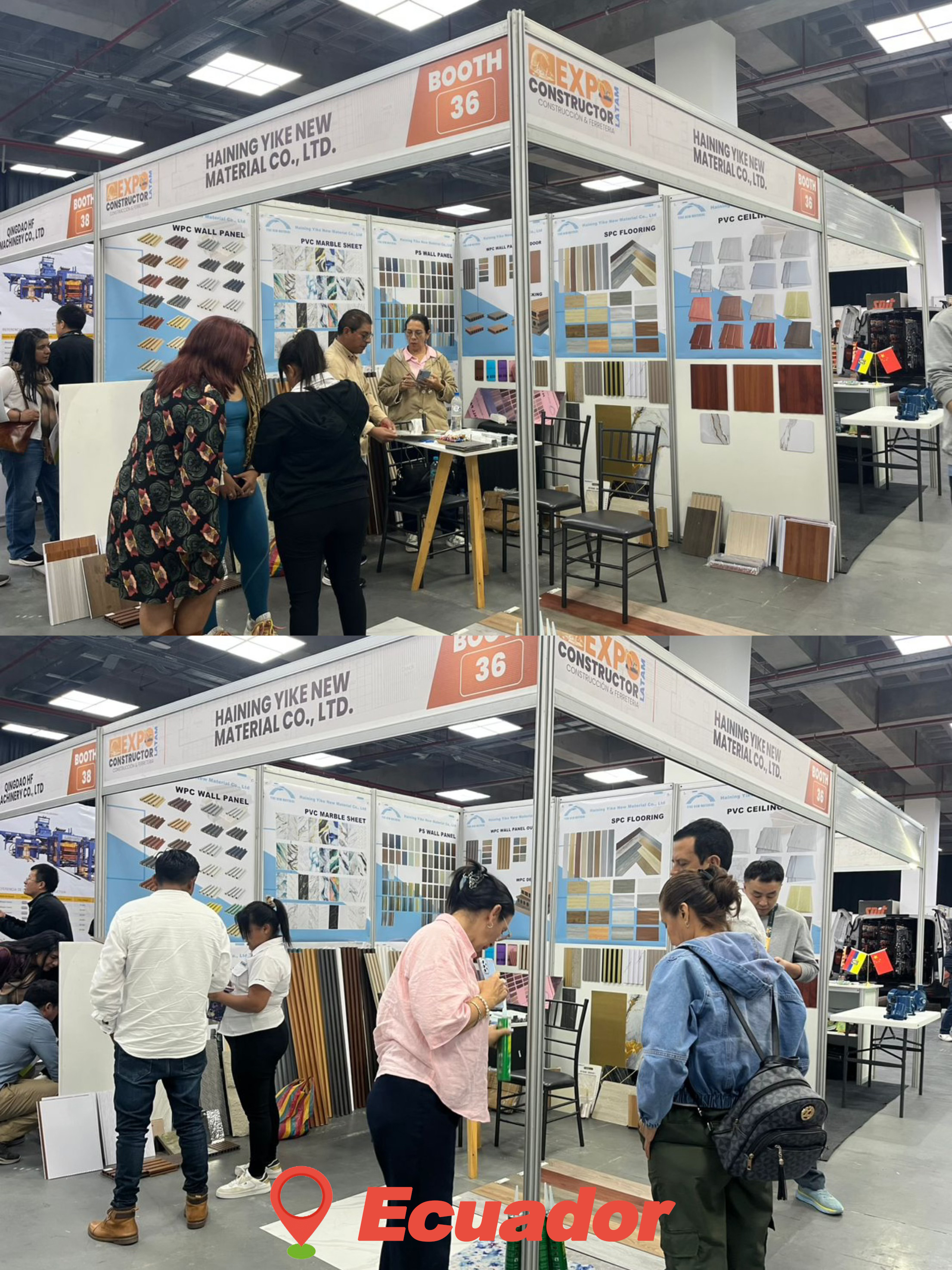
Ecuador — commercial interiors. A building materials distributor and wholesaler received 3 × 40HQ containers of decorative materials over a 2-year partnership: PVC ceiling panels, PVC marble sheets and WPC wall panels, applied in retail shops, brand stores, showrooms, offices and restaurants. Commercial interiors are where fire classification questions appear first, which is why the documentation had to be organized per product line rather than per container.
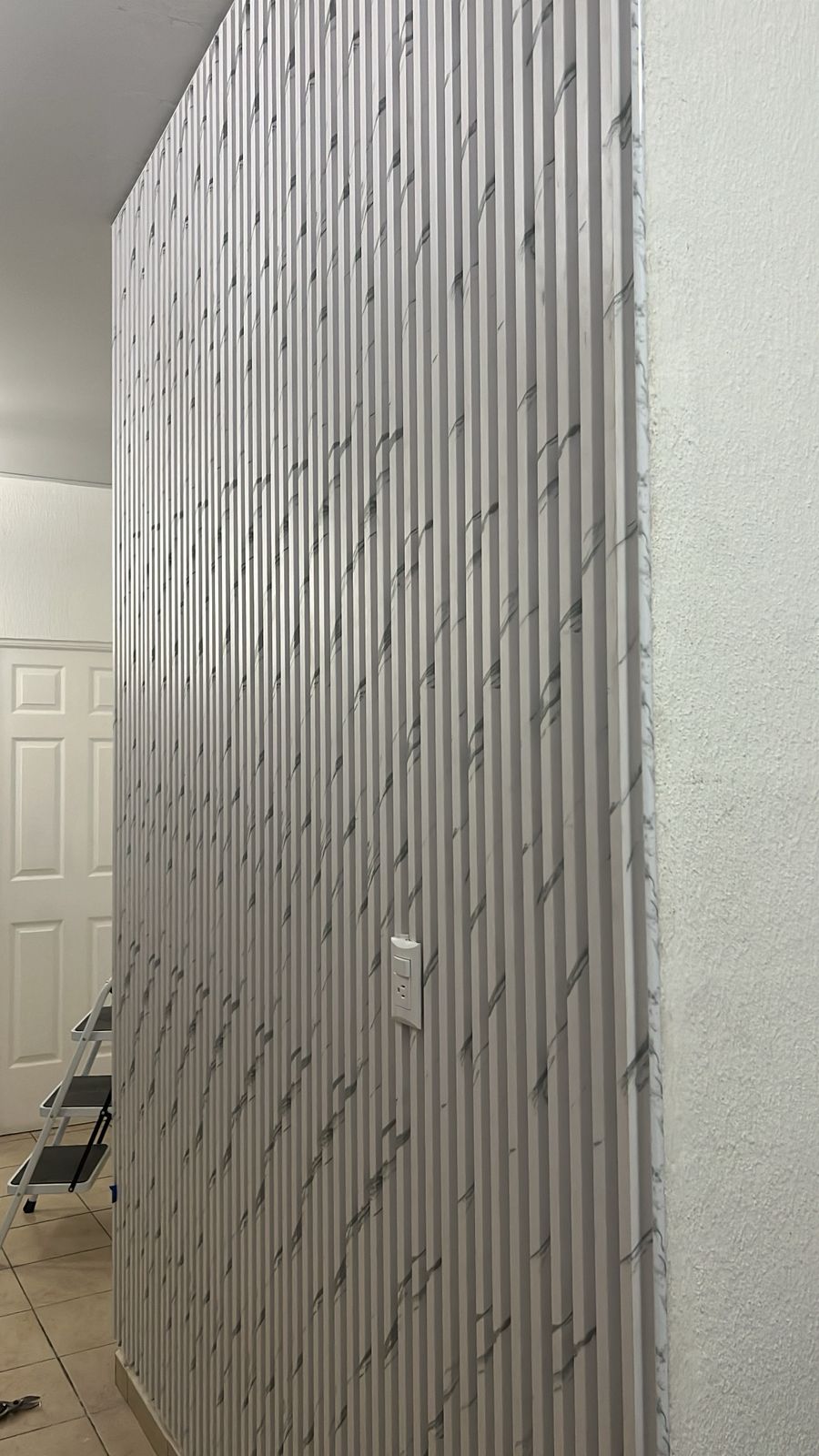
El Salvador — residential decoration. One 40HQ container of PVC ceiling panels, PVC marble sheets and WPC wall panels was supplied for residential projects, where the practical compliance questions are moisture behavior, mildew resistance and installation guidance rather than commercial fire classification. Residential buyers also ask about surface cleaning and daily maintenance, which documentation for these product lines addresses directly.
Indonesia — long-cycle renovation supply. A 3-year cooperation with continuous orders and 10 × 40HQ containers of PVC ceiling panels, PVC marble sheets and WPC wall panels, applied across residential and commercial renovation projects. Tropical humidity is the recurring theme: moisture-proof performance, anti-mildew behavior and packaging that survives long sea transit.
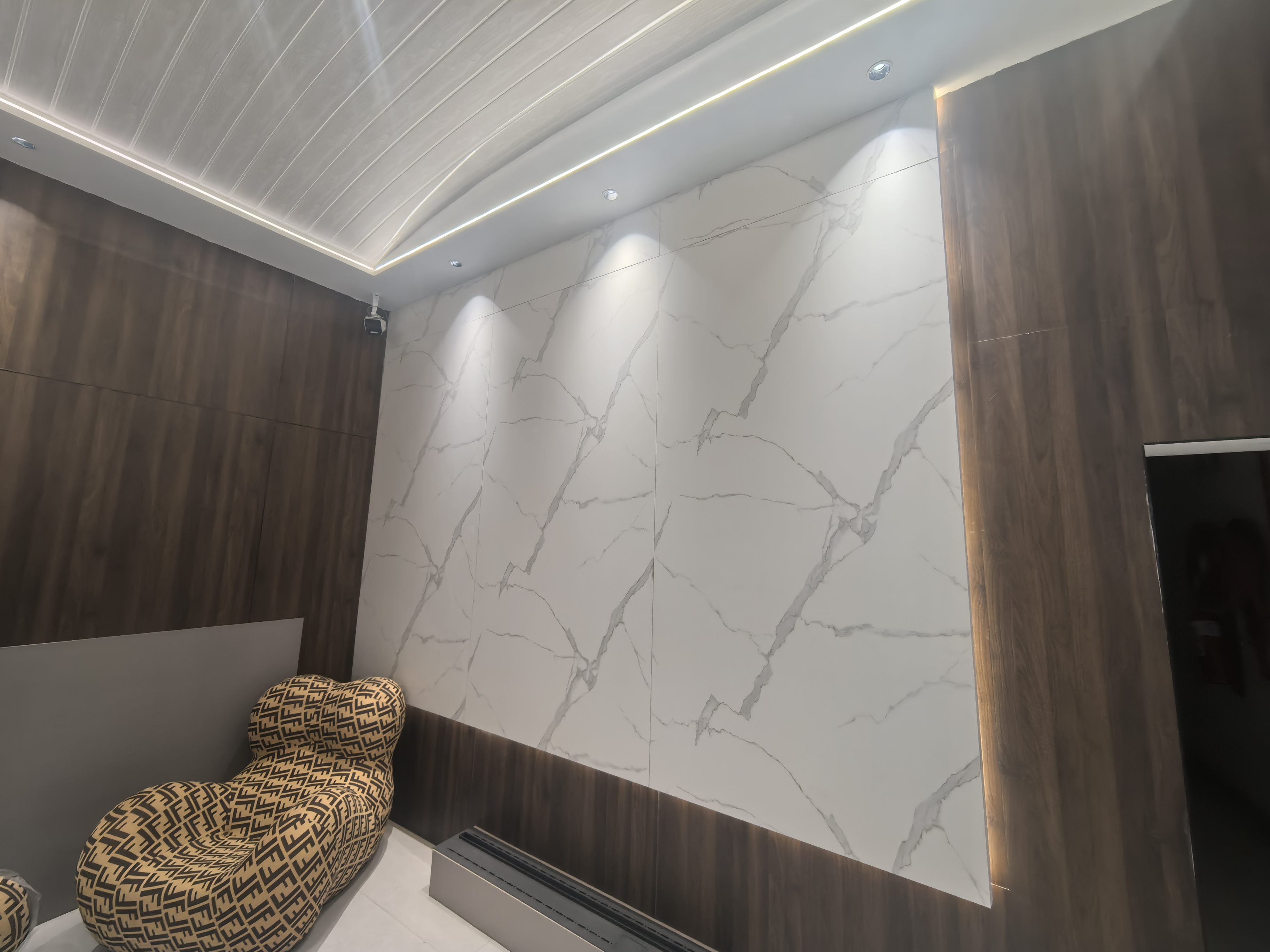
Malaysia — residential scale with tropical exposure. YIKE decorative panels have been installed in over 100 residential houses in Malaysia, with 10 × 40HQ containers shipped to a building materials distributor and ongoing demand for new renovation projects. At this scale, the most common specification error is mixing indoor WPC panels with outdoor WPC profiles, which the documentation explicitly separates.
Colombia — high-frequency repeat supply. More than 60 × 40HQ containers per year were supplied to a building materials distributor over a 2-year period, covering PVC ceiling panels, PVC marble sheets and WPC wall panels. High-frequency repeat supply puts pressure on batch consistency, so batch-level color and quality records matter as much as the initial test report.
Comparison Table: Six Product Lines and Their Documentation Focus
| Product line | Construction | Size / thickness range | Application zone | Primary compliance question | Documentation to request |
|---|---|---|---|---|---|
| PVC wall panel | PVC + calcium carbonate + additives | 1220 × 2440 mm; 1220 × 2800 mm; 5 mm / 8 mm | Interior wall | Fire classification and water absorption of interior wall finishes | Report naming thickness, pattern and finish; resin quality reference (ASTM D1784 where specified) |
| PVC ceiling panel | PVC resin + calcium carbonate + additives; PVC content 35%–50% | Widths 200–600 mm; thickness 6–10 mm; lengths 2900–5950 mm | Interior ceiling | Ceiling fire/smoke behavior, humidity and heat exposure | Report per thickness and finish; formulation declaration; packaging specification |
| PVC marble sheet / UV marble sheet | PVC resin + calcium carbonate + additives; UV or high gloss coating | 1220 × 2440 mm; 1220 × 2800 mm; 2.0–3.0 mm | Interior wall (not long-term outdoor) | Surface durability, light fastness and application limits | Light fastness reference (ISO 105-B02), water absorption reference (ASTM D570 / ISO 62), finish-specific approval |
| WPC wall panel (interior fluted) | PVC/PE + wood fiber + additives | Models 150*10 to 200*20, length 2900 mm | Interior wall (not open-air outdoor) | Moisture and mildew behavior in humid interior spaces | Interior-use statement, moisture-related test reference, installation method (clip / screw / glue) |
| Outdoor WPC wall panel | Wood fiber + HDPE + additives; co-extrusion or traditional | Widths 140–219 mm; thickness 13/20/26 mm; length 2.9 m | Exterior facade and outdoor structures | UV and weather resistance, wind pressure, thermal movement | Outdoor aging test report, co-extrusion vs traditional construction statement, fixing and expansion-gap specification |
| PVC self-adhesive wall sticker | PVC, 2.5 mm | Widths 600 / 1200 mm; roll length 3 m | Interior peel-and-stick surface | Adhesion, removal residue and wet-area limitations | Adhesive test data, anti-yellowing statement, substrate preparation and wet-area restriction note |
Standards Reference: What Each Method Actually Covers
| Standard / method | Region | What it covers | Where it applies in this product range |
|---|---|---|---|
| ASTM E84 (UL 723) | North America | Primary fire test standard for interior wall and ceiling finishes; Class A requires a Flame Spread Index of 0–25 | Large-format interior PVC wall panels and PVC ceiling panels in commercial interiors |
| EN 13501-1 | EU | Reaction-to-fire classification of construction products; PVC panels often target Class B-s1, d0 for commercial use | Interior PVC wall and ceiling panels specified for EU projects |
| ASTM D1784 | Global / North America | Cell classification for rigid PVC compounds; Cell Class 12454 is commonly referenced for building panels | PVC resin-based panels where resin quality is part of the specification |
| ASTM D570 / ISO 62 | Global | Standard test methods for water absorption of plastics and composites | PVC and WPC panels in humid and wet interior zones |
| ISO 105-B02 | Global | Color fastness to artificial light using a xenon arc fading lamp | UV-coated marble sheets, printed and laminated surfaces, and light-exposed profiles |
The table above lists the standard families most frequently referenced by buyers in North America and the EU. It is a reference for what to request — not a statement that any specific SKU in this range has been tested to every method listed. Confirm coverage per SKU in writing.
FAQ: Compliance, Capability, Budget, Samples and Lead Time
Which standards should I request when importing PVC wall panels, ceiling panels or WPC panels?
Request by application, not by product name alone. For interior wall and ceiling finishes in North America, ASTM E84 (UL 723) is the primary fire test standard, and Class A requires a Flame Spread Index of 0–25. For EU projects, reaction-to-fire classification follows EN 13501-1, where PVC panels often target Class B-s1, d0 for commercial use. For water-related performance, ASTM D570 and ISO 62 are the standard water absorption test methods; for UV-coated and printed surfaces, ISO 105-B02 covers color fastness to artificial light; and for rigid PVC compound quality, ASTM D1784 defines cell classification, with Cell Class 12454 commonly referenced for building panels. A report only answers your question when it names the same thickness, width, surface finish and batch as the SKU you are importing.
How can I verify a factory’s production and OEM/ODM claims before ordering?
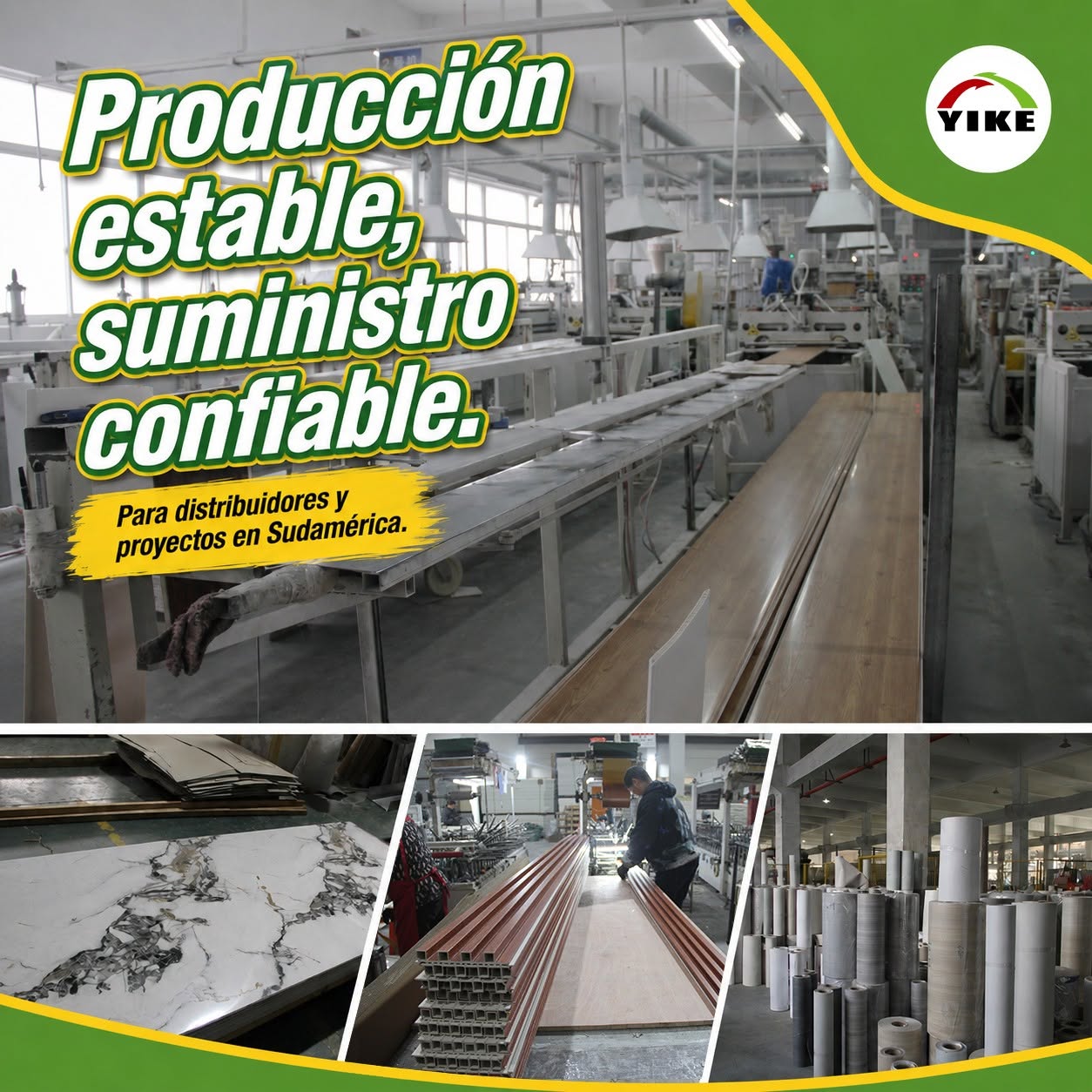
Cross-check the claim against traceable production facts. YIKE NEW MATERIAL operates a 10,000 m² factory in Haining, Jiaxing City, Zhejiang Province, with 50 employees, a 10-engineer R&D team, a monthly capacity of 500,000 m² and an annual output of 5,000,000 m², exporting 100% of production to Central America, South America, Southeast Asia, the Middle East and Africa. OEM and ODM work covers color, pattern and logo customization. Quality control is documented as 100% pre-shipment testing plus third-party inspection (SGS) services. Verify by requesting a pre-production sample in your own color or pattern, confirming which inspection body performs the check, and asking for the capacity basis behind the quoted lead time.
What drives the cost per square meter, and how does the MOQ structure work?
Cost is driven mainly by the resin-to-filler ratio and the surface system. PVC ceiling panels document a PVC content range of 35%–50%, which is customizable, and surface finishes range from printing to hot stamping to laminated. Construction also matters: co-extruded outdoor WPC profiles and traditional WPC profiles are different builds, as are high gloss and matte UV marble sheets, and thickness steps from 2.0 mm to 3.0 mm change material consumption. On order structure, the MOQ is one 20’ container with 4–6 colors from the E-catalog; if your quantity is less than one container, 500 sqm per color from stock colors or 1,000 sqm from the E-catalog is the available option. Buyers should therefore compare offers on the same construction, thickness and finish before comparing price.
Can I validate quality with samples before committing to a full container?
Yes, and the sample test should match the compliance question you are worried about. For self-adhesive PVC rolls, test adhesive viscosity, removal residue and anti-yellowing on your own wall substrate, remembering that the wall must be flat, clean and dry, and that continuous water contact zones such as shower areas are not recommended. For UV marble sheets, check surface gloss consistency, scratch behavior and the difference between standard and upgraded anti-scratch finishes. For WPC panels, confirm the installation method — clip, screw or glue for interior fluted panels, and anti-rust keel with reserved expansion gaps for outdoor profiles. Sample approval should be recorded per SKU so that bulk production can be compared against it.
What lead time should I plan for, and how do I organize documentation for the first container?
Production lead time is 14–30 days, and the documentation package should be finalized before production starts, not after. For a first container, confirm the color selection from the E-catalog, the packaging format — PE film or carton for PVC ceiling panels, with customized packaging available — and the inspection arrangement, since third-party inspection (SGS) services are offered on this range. Documentation should be issued per SKU: construction declaration, applicable test reference, sample approval record and packaging specification. To start a sample, quotation or documentation request, contact YIKE NEW MATERIAL at sales@merchandise-eco.com or WhatsApp +86 188-5830-7787, and download the 2026 product brochure for the full range overview.
Conclusion: Match the Document to the Product, Not to the Order
Compliance in PVC and WPC decorative panels is not a single certificate that travels with a container. It is a mapping exercise: interior wall panels, ceiling panels, UV-coated marble sheets, interior fluted WPC, co-extruded outdoor WPC and self-adhesive PVC rolls each carry a different construction, a different application zone and therefore a different set of regional questions. ASTM E84 Class A, EN 13501-1, ASTM D1784, ASTM D570 / ISO 62 and ISO 105-B02 are the reference frameworks most frequently requested by buyers in North America and the EU — and the report only becomes usable when it names the exact thickness, width and finish being shipped.
The same discipline applies to supplier verification. Documented capacity, OEM/ODM scope, sample approval and inspection arrangements should all be confirmed before the first container, and repeated per batch on every order after it.
Next Step: Sample, Quotation or Documentation Request
YIKE NEW MATERIAL (Haining Yike New Material Co., Ltd.) supplies PVC ceiling panels, PVC wall panels, PVC marble sheets, UV marble sheets, WPC wall panels, outdoor WPC wall panels, PVC decorative panels and PVC self-adhesive wall stickers to importers, distributors and project buyers in Central America, South America, Southeast Asia, the Middle East and Africa.
Email: sales@merchandise-eco.com | Tel / WhatsApp: +86 188-5830-7787 | Website: www.merchandise-eco.com | Blog: blog.merchandise-eco.com
Address: Room 1315, NO. 273 Haining Avenue, Haizhou Street, Haining, Jiaxing City, Zhejiang Province, China. Download the 2026 product brochure: (2026) YIKE New Material PDF
Have Questions or Need More Details?
Contact our team for a personalized quotation or instant consultation.
Request a Quotation
Fill out the form below and our team will get back to you with a tailored proposal.
WhatsApp Direct Chat
Prefer to chat in real-time? Message us on WhatsApp for instant assistance & quick answers.
- Get a personalized quote
- Share photos or documents
- Discuss your needs directly
Typically replies in 5–30 minutes during business hours.