
Decorative Panel Names Explained: PVC, WPC & Marble Sheets
Decorative Panel Names Explained: PVC, WPC & Marble Sheets
Short answer: decorative panel names mix four different things. PVC and WPC describe the material; panel, sheet and sticker describe the form; marble, UV and fluted describe the finish or the profile; and ceiling, outdoor or self-adhesive describe where or how the product is installed. Once those four layers are separated, the five products in this guide stop overlapping.
That separation matters at quotation stage. A 3 mm PVC marble sheet and a rigid PVC wall panel are both written as PVC panel on a price list, yet they use different substrates, different fixing methods and different joint treatments. A price comparison made on the name alone is therefore not a comparison of the same product.
This guide decodes PVC wall panels, PVC ceiling panels, PVC marble sheets (also listed as UV marble sheets or PVC marble wall panels), WPC wall panels (including WPC fluted wall panels and outdoor WPC wall panels) and PVC self-adhesive wall stickers. For each one it states what the product actually is, where it belongs, and which detail to confirm first. YIKE NEW MATERIAL (Haining Yike New Material Co., Ltd.) manufactures and exports this product family, and the specification examples below come from that range.
Why One Panel Can Carry Five Names
A decorative panel name is written by whoever prepares the catalogue. It is a label, not a classification system, and the label changes with the audience: a factory writes the profile code, a distributor writes the material, a retailer writes the room, and a designer writes the look. The same fluted WPC profile can appear as a fluted wall panel in one line and as YK-160*20*2900mm in another, with no material name at all.
Four naming layers cause most of the confusion:
- Material layer — PVC (polyvinyl chloride) or WPC (wood-plastic composite). This layer decides density, impact resistance, moisture behaviour and price bracket.
- Form layer — panel, board, sheet, strip, profile or film. This layer decides thickness range, panel size and how joints are resolved.
- Finish layer — marble print, UV coating, laminated film, printed design, fluted or flat face. This layer decides appearance and surface durability.
- Installation layer — keel-fixed, adhesive-bonded or self-adhesive. This layer decides which accessories the order needs and which substrate conditions apply.
Even published market research shows the boundary problem. Dataintelo estimated the global PVC panels market at USD 14.8 billion in 2025, while a Metastat Insights estimate covering PVC wall panels only puts that narrower segment at USD 5.84 billion. The gap is largely a definition gap, because broader figures include flooring, profiles and exterior systems that are not wall cladding. Dataintelo also reports that PVC wall panels accounted for 42.5% of the PVC panels market by product type in 2025, and Metastat projects synthetic marble — the group that includes PVC marble sheets — growing at a 6.8% CAGR from 2025 to 2032. These are third-party estimates rather than supplier data, but they explain why marble and wall panel labels keep multiplying in catalogues.
The Five-Name Map: What Each Product Actually Is
The table below maps each common name to the product behind it. The final column is the detail that most often differs between two quotes using the same wording.
| Name you will see | What the product actually is | Typical form | Where it belongs | First thing to check |
|---|---|---|---|---|
| PVC wall panel / PVC decorative panel | Rigid PVC interior wall cladding; water-resistant jointed panels | Strip panel in fixed widths, fixed to a keel or bonded with adhesive | Interior walls, including humid-prone indoor rooms | Thickness, joint system, fixing method |
| PVC ceiling panel | The same PVC cladding family in a ceiling format | 200–400 mm wide, 6–9 mm thick in YIKE ceiling models | Kitchens, bathrooms, corridors, shop and office ceilings | Keel, trims and light cut-outs in the quote |
| PVC marble sheet / UV marble sheet / PVC marble wall panel | UV-coated board made from PVC resin and calcium carbonate with a marble print | 1220 × 2440 mm or 1220 × 2800 mm, 2–3 mm thick | Interior feature walls, reception areas, showrooms, bathroom walls without continuous soaking | Coating type, joint plan, anti-scratch upgrade |
| WPC wall panel / WPC fluted wall panel | Wood-plastic composite profile; YIKE guidance describes higher density and stronger impact resistance than ordinary PVC panel | 150–200 mm wide, 10–24 mm deep, 2900 mm long in YIKE profiles | Interior walls, basements, hotel bathrooms, high-traffic interiors | Substrate behind “fluted”, density, keel spacing |
| Outdoor WPC wall panel | Exterior-grade WPC cladding with a UV-resistant, weather-resistant formulation; supplied as traditional or co-extruded panels | Exterior profile fixed on an anti-rust metal keel | Façades, compound walls, villa and commercial exteriors | Construction type, outdoor ageing report, fastener specification |
| PVC self-adhesive wall sticker | Adhesive-backed PVC film applied directly to the wall as a covering | Roll or sheet film with release paper | Flat, clean, dry interior walls; not shower zones | Adhesive strength, anti-yellowing, backing paper quality |
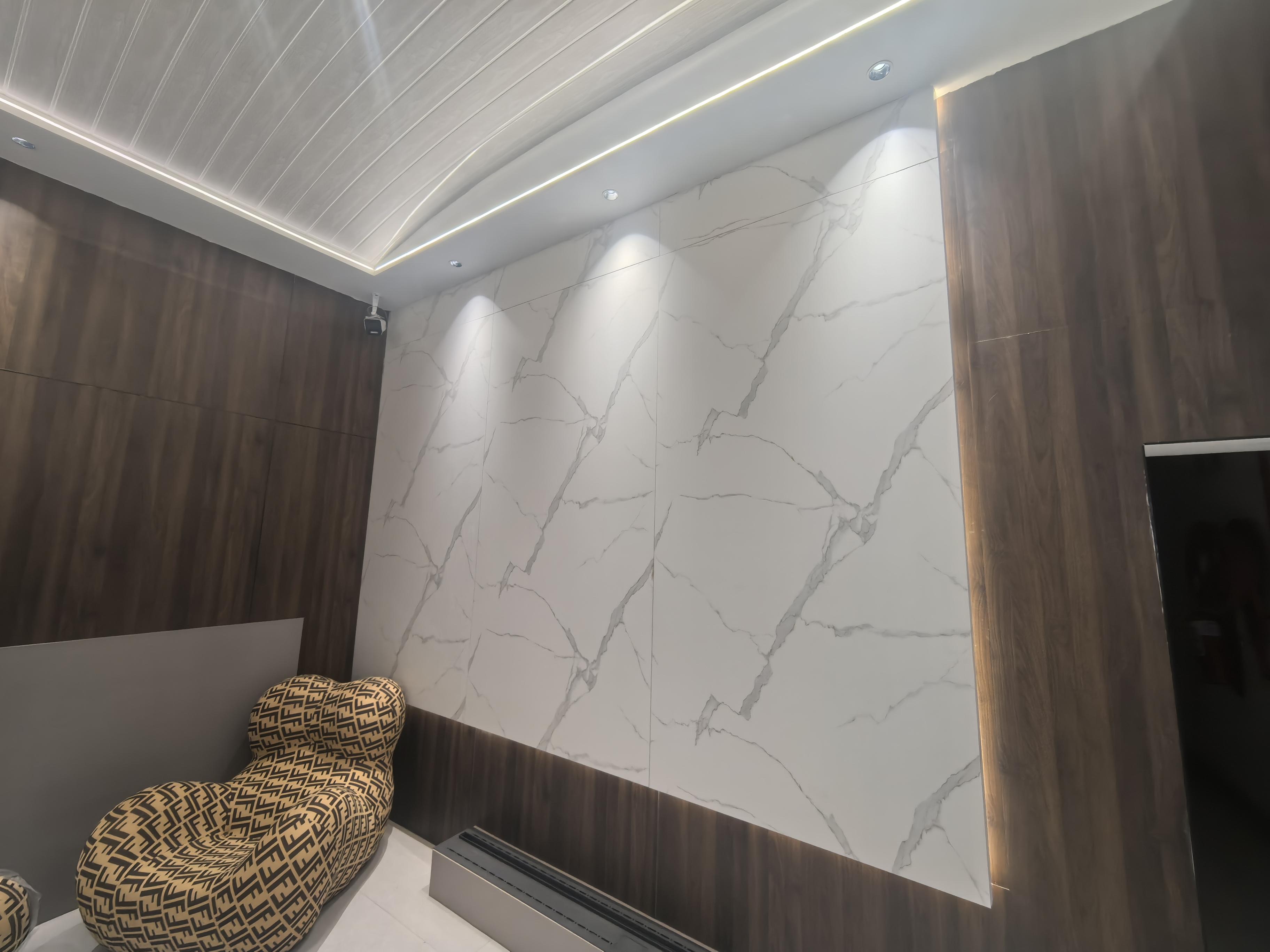
Decorative panel ranges are usually displayed side by side, which is where catalogue names and actual products first diverge for a buyer.
PVC Wall Panel and PVC Ceiling Panel: Waterproof Interior Cladding in Two Formats
A PVC wall panel is rigid polyvinyl chloride interior wall cladding. Its defining property is water resistance: the panel does not absorb water, so it resists the swelling, staining and mildew that affect wood-based boards in humid rooms. It is installed as jointed panels — fixed to a keel system or bonded with adhesive — and closed with trims at corners and edges.
A PVC ceiling panel is the same material family in a ceiling format. YIKE's published ceiling models run from 200 mm to 400 mm in width and from 6 mm to 9 mm in thickness, from YK-200*6mm through YK-400*8mm, with PVC content of 35%–50%. Those figures serve one specific purpose here: they show that PVC panel in a quotation can mean a narrow, thin strip rather than a large board.
The name does not tell you three things that change the delivered result:
- Fixing method and accessories. A keel-fixed ceiling needs a keel frame, fixing accessories and corner lines; an adhesive-fixed wall needs a levelled base and an appropriate adhesive. Neither is visible in the product title.
- Fire performance. YIKE states that some models reach B1 flame retardant grade, which is a statement about specific models, not the whole range. For projects, ask for the report matching your market. In North America, ASTM E84 (UL 723) is the reference fire test for interior wall and ceiling finishes, and a Class A rating requires a Flame Spread Index of 0–25. In the EU, reaction to fire is classified under EN 13501-1, where Class B-s1, d0 is often the target for commercial PVC panel work.
- Material test references. ASTM D1784 covers the cell classification of rigid PVC compounds, with Cell Class 12454 commonly used for building panels; water absorption is tested under ASTM D570 or ISO 62; colour fastness to artificial light is tested under ISO 105-B02, the xenon arc fading lamp method.
For a buyer, the practical consequence is simple: PVC panel, 8 mm and PVC panel, 3 mm are two different products. The first is likely a ceiling strip or wall strip; the second is likely a marble sheet. Confirm which before comparing unit prices.
PVC Marble Sheet, UV Marble Sheet and PVC Marble Wall Panel: One Board, Three Labels
All three names describe the same product: a UV-coated board made from PVC resin and calcium carbonate, printed with a marble design. PVC marble sheet names the material and the look, UV marble sheet names the surface treatment, and PVC marble wall panel names the application. YIKE lists this product at 1220 × 2440 mm and 1220 × 2800 mm in thicknesses from 2 mm to 3 mm.
The product is an indoor decorative board. It has good moisture resistance and can be used in dry and wet indoor areas such as bathrooms, provided continuous soaking in water is avoided during installation and use. It is not recommended for long-term outdoor use, because sustained UV sunlight exposure causes surface fading and ageing.
Compared with natural marble, the board is lighter, lower cost and faster to install, and it needs less daily maintenance. It simulates a marble texture rather than reproducing stone, which is the basis of its cost position in interior work. The standard UV finish provides basic anti-scratch performance; an upgraded anti-scratch surface is available on request for project work, and strong friction or hard sharp impact should still be avoided.
Two naming traps are worth flagging. First, marble is a finish name, not a material: a marble-labelled item still needs its substrate stated as PVC resin and calcium carbonate rather than left implied. Second, wall panel in the product name refers to the application, not to the rigid cladding family. A 2–3 mm marble sheet is adhesive-bonded in a board format with trimmed or butted joints, while a PVC wall or ceiling strip is mechanically fixed. The two are installed by different trades with different accessories, and a 2800 mm board can cover a 2.8 m wall height with a single board, which changes the joint plan on tall walls.
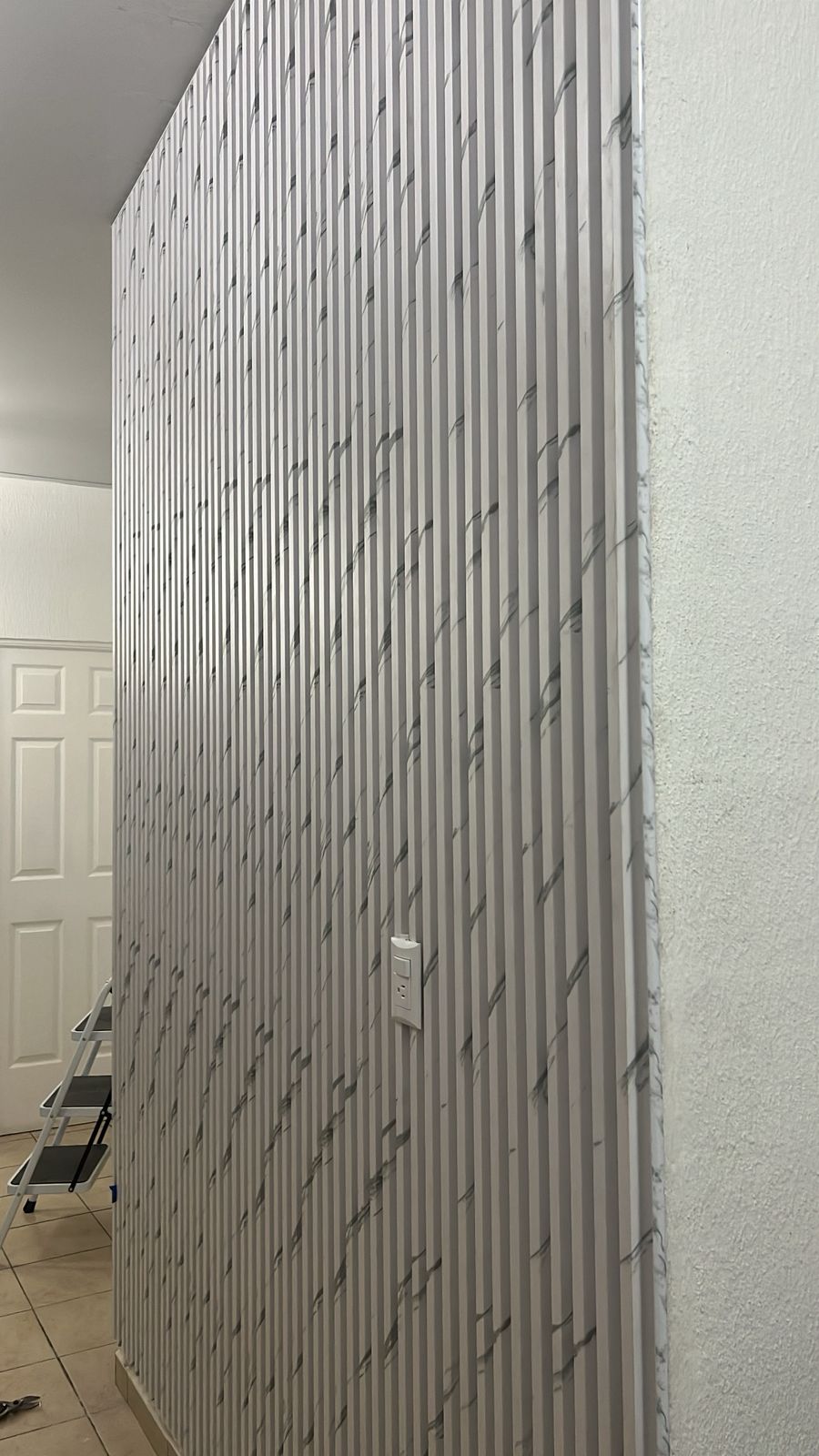
Residential work typically combines several panel types in one property, which is why the order has to be written by product name and area.
WPC Wall Panel and WPC Fluted Wall Panel: When “Wood” Means Wood-Plastic Composite
WPC stands for wood-plastic composite. A WPC wall panel is a composite profile, and YIKE's product guidance describes it as having higher density than ordinary PVC panel, with stronger impact resistance, better mildew and moisture resistance and less deformation. That makes it a fit for interior walls in frequent-use and humid interiors, including basements and hotel bathrooms, while remaining an indoor product that is not suitable for open-air exposure. Ordinary PVC panel keeps a price advantage for simple, lower-budget decoration, so the WPC name is not automatically the correct choice for every wall.
YIKE's WPC wall panel profiles include YK-160*20*2900mm, YK-160*24*2900mm, YK-150*10*2900mm, YK-168*24*2900mm, YK-150*15*2900mm and YK-200*20*2900mm — widths of 150–200 mm, depths of 10–24 mm, all 2900 mm long.
Fluted is a profile name, not a material name. It describes a grooved or reeded face. Because a fluted face can exist on more than one substrate, a line item that says only fluted wall panel does not confirm the material. Ask for the substrate (WPC or PVC), the profile code and the flute depth, and check the keel spacing the supplier specifies for that depth.
Outdoor WPC Wall Panel: The Exterior Grade Behind the Same Acronym
Outdoor WPC wall panel is exterior cladding, and the difference from the indoor product is formulation rather than naming. YIKE states that outdoor panels add a UV-resistant, weather-resistant formula to resist sunlight, temperature change and rain erosion, and that an indoor WPC panel used on a façade will fade and crack quickly. The two products share an acronym; they do not share an application.
Outdoor panels are supplied as traditional or co-extruded exterior panels, and both constructions are sold under the same outdoor WPC wall panel name. The construction should therefore be confirmed in writing rather than assumed from the title, together with the surface layer the supplier is offering.
Installation is part of the specification, not an afterthought: exterior work uses a corrosion-resistant metal keel, dedicated stainless steel fasteners, reserved expansion gaps for thermal movement, and sealing and drainage details so rainwater does not sit behind the panels. On colour, YIKE notes that outdoor-grade WPC uses UV-stabilised raw materials to slow fading, and that a slight natural colour change after years of exposure is normal. Ask for the outdoor ageing report rather than relying on the word outdoor in the product name.
PVC Self-Adhesive Wall Sticker: A Covering for Fast Refresh, Not Cladding
A PVC self-adhesive wall sticker is an adhesive-backed PVC film. It is not a structural panel: it is applied directly to a flat, clean, dry wall as a covering, which is why this product family is described as DIY-friendly rather than as cladding. YIKE's guidance for the range covers surface texture, adhesive viscosity, anti-yellowing performance, backing release paper quality and printing clarity.
Its limits are specific. It is not recommended for a shower zone with continuous water contact, because long-term water immersion causes edge warping and peeling; it performs on dry, flat indoor walls such as living rooms, bedrooms and dry bathroom areas. On removal, the film can be peeled off with little residual glue under suitable indoor temperatures and a standard service period, while many years of use or prolonged high temperature may leave a small amount of residue on the wall.
The installation sequence is short and mostly about preparation:
- Clean the wall and let it dry fully.
- Measure the area and cut the film to size.
- Peel the backing release paper slowly.
- Apply from top to bottom, pressing out air bubbles with a scraper.
- Trim the edges and check the overall adhesion.
Because the product is thin film, the name check is different from the panel checks above: adhesive strength, anti-yellowing, backing paper quality and print definition decide the outcome, not thickness in millimetres.
Matching the Name to the Project: A Fit-Based Shortlist
When several names could apply to the same wall, decide by the surface conditions first and the name second. The shortlist below orders products by how directly they address each requirement. It is a fit-based priority for specification work, not a market ranking.
| Project requirement | Shortlist first | Why it fits | Confirm before ordering |
|---|---|---|---|
| Ceiling in a kitchen, bathroom or shop with moisture and cooking fumes | PVC ceiling panel | Water-resistant cladding that does not absorb water, in a modular ceiling format | Keel spacing, trim set, cut-outs for lights and fans |
| Interior wall that takes regular impact | WPC wall panel | Higher density and stronger impact resistance than ordinary PVC panel, per YIKE guidance | Profile depth, density statement, fixing method |
| Feature wall, reception or showroom that should read as stone | PVC marble sheet | Printed marble finish with UV coating; lighter and lower cost than natural marble | Sheet thickness, joint plan, anti-scratch upgrade |
| Façade, compound wall or villa exterior | Outdoor WPC wall panel | Exterior formulation with UV and weather resistance | Traditional or co-extruded, ageing report, fastener specification |
| Fast refresh of a rental unit, shop or office with minimal disruption | PVC self-adhesive wall sticker | Self-adhesive application with no keel and no adhesive mixing | Wall flatness and dryness, adhesion test, removal expectation |
| Large wall where joints should be minimised | 1220 × 2800 mm marble sheet or 200 mm WPC profile | Fewer joints to align across the same wall area | Handling and site access for long boards, delivery format |
Six Checks That Separate One Name From Another in a Quotation
- Material line. Does the item state PVC, WPC, or PVC resin and calcium carbonate? A title alone is not a material statement.
- Form, size and thickness with units. A 1220 × 2440 mm board at 3 mm and a 200 mm wide strip at 8 mm are different products with different fixing methods.
- Grade statement. Interior, or exterior with a UV-resistant formulation? This must be written, not inferred from the colour or the photo.
- Finish and profile. UV coating, printed marble, laminated film, co-extruded surface or fluted profile — and the flute depth where relevant.
- Fixing and accessories. Keel-fixed, adhesive-bonded or self-adhesive, plus trims, corner pieces, fasteners and sealing strips in the same quotation.
- Test reference. The standard your market applies, for example ASTM E84 Class A with Flame Spread Index 0–25 in North America, EN 13501-1 B-s1, d0 as a common EU commercial target, ASTM D570 or ISO 62 for water absorption, and ISO 105-B02 for colour fastness. Ask for the report, not the adjective.
How YIKE Labels and Supplies These Product Families
YIKE NEW MATERIAL is the trading name of Haining Yike New Material Co., Ltd., a manufacturer and exporter of PVC and WPC decorative building materials founded in 2019. The company runs a 10,000 m² factory with 50 employees, an R&D team of 10 engineers and annual output of 5,000,000 m², and exports 100% of its production to Central America, South America, Southeast Asia, the Middle East and Africa.
Its product list covers the names discussed in this guide: PVC ceiling panel, PVC wall panel, PVC marble sheet, UV marble sheet, PVC marble wall panel, WPC wall panel, WPC fluted wall panel, outdoor WPC wall panel, PVC decorative panel and PVC self-adhesive wall sticker. Because one factory ships all of these categories, the product name on the order — not the supplier identity — is what decides whether the right panel arrives.
Commercial terms follow the same logic. Monthly capacity is 500,000 m², lead time is 14–30 days, and OEM/ODM work covers colour, pattern and logo customisation. Quality control is a 100% pre-shipment test with third-party inspection by SGS, and after-sales support is provided remotely. The MOQ is one 20-foot container with 4–6 colours from the E-catalogue; below container volume, 500 m² per colour can be ordered from stock colours, or 1,000 m² per colour from the E-catalogue.
Documented supply work shows how mixed product names appear in practice. An Indonesian renovation service provider has imported 10 × 40HQ containers over three years, combining PVC ceiling panels, PVC marble sheets and WPC wall panels across residential and commercial projects. A Malaysian distributor has completed more than 100 residential installations. An Ecuadorian distributor took 3 × 40HQ containers for retail shops, brand stores, showrooms, offices and restaurants, using PVC ceiling panels for ceilings, PVC marble sheets for feature walls and WPC wall panels for interior wall finishes. Full company information is available at YIKE NEW MATERIAL; specification questions can go to sales@merchandise-eco.com or +86 188-5830-7787.
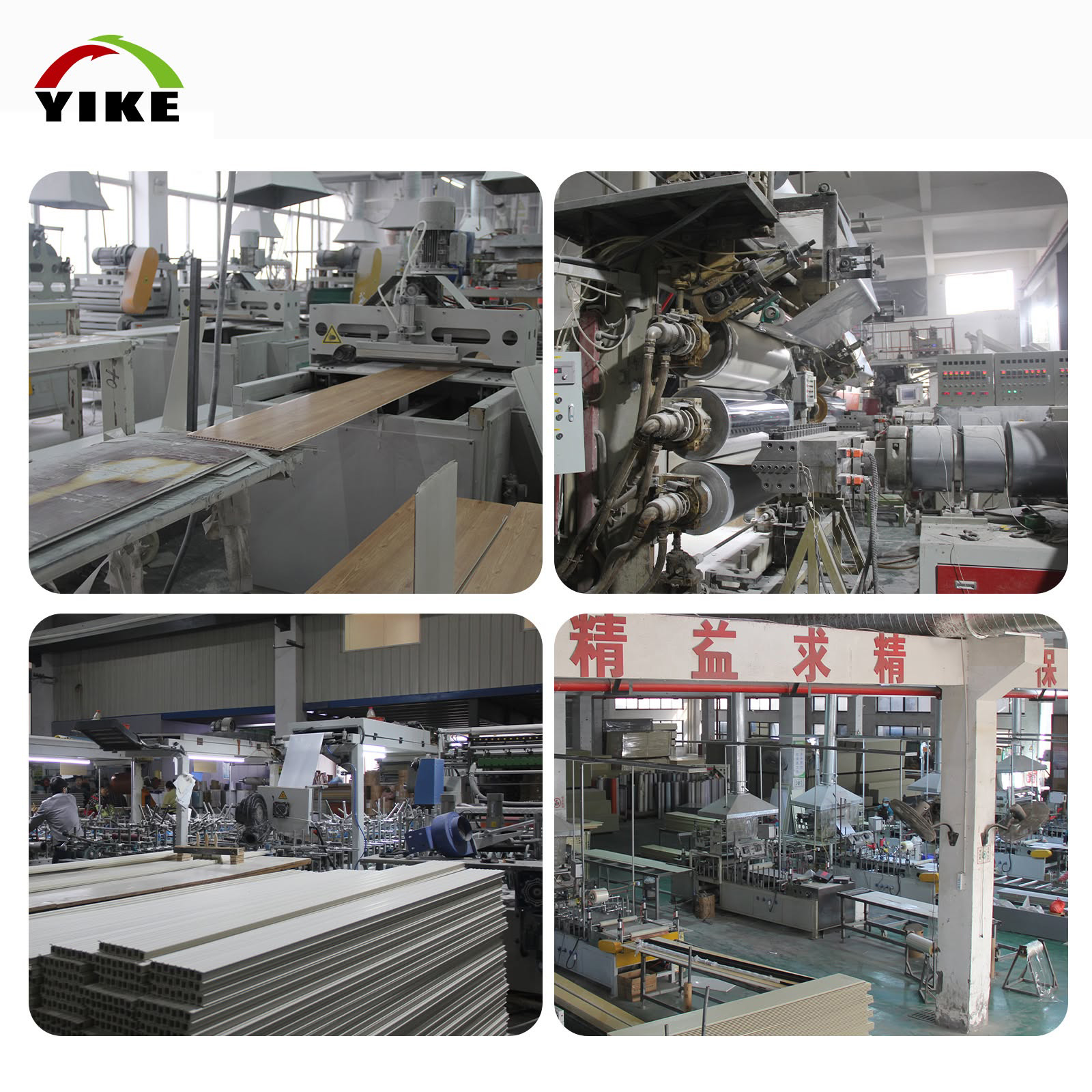
Production of PVC ceiling panels, PVC wall panels, marble sheets and WPC profiles under one roof.
Conclusion: Decode the Name Before You Compare the Price
The naming problem in decorative panels is not a vocabulary problem; it is a specification problem. PVC wall panels are waterproof interior wall cladding, PVC ceiling panels are the same material in a ceiling format, PVC marble sheets — including UV marble sheets and PVC marble wall panels — are UV-coated PVC resin and calcium carbonate boards, WPC wall panels are wood-plastic composite profiles for interior use whether flat or fluted, outdoor WPC wall panels are the exterior-grade version of that composite, and PVC self-adhesive wall stickers are an adhesive film for fast interior refresh.
Before comparing two prices, confirm the material line, the form and thickness, the interior or exterior grade, the finish or profile, and the fixing method. If those five items match, the names no longer matter. If they do not match, the two prices were never comparable in the first place.
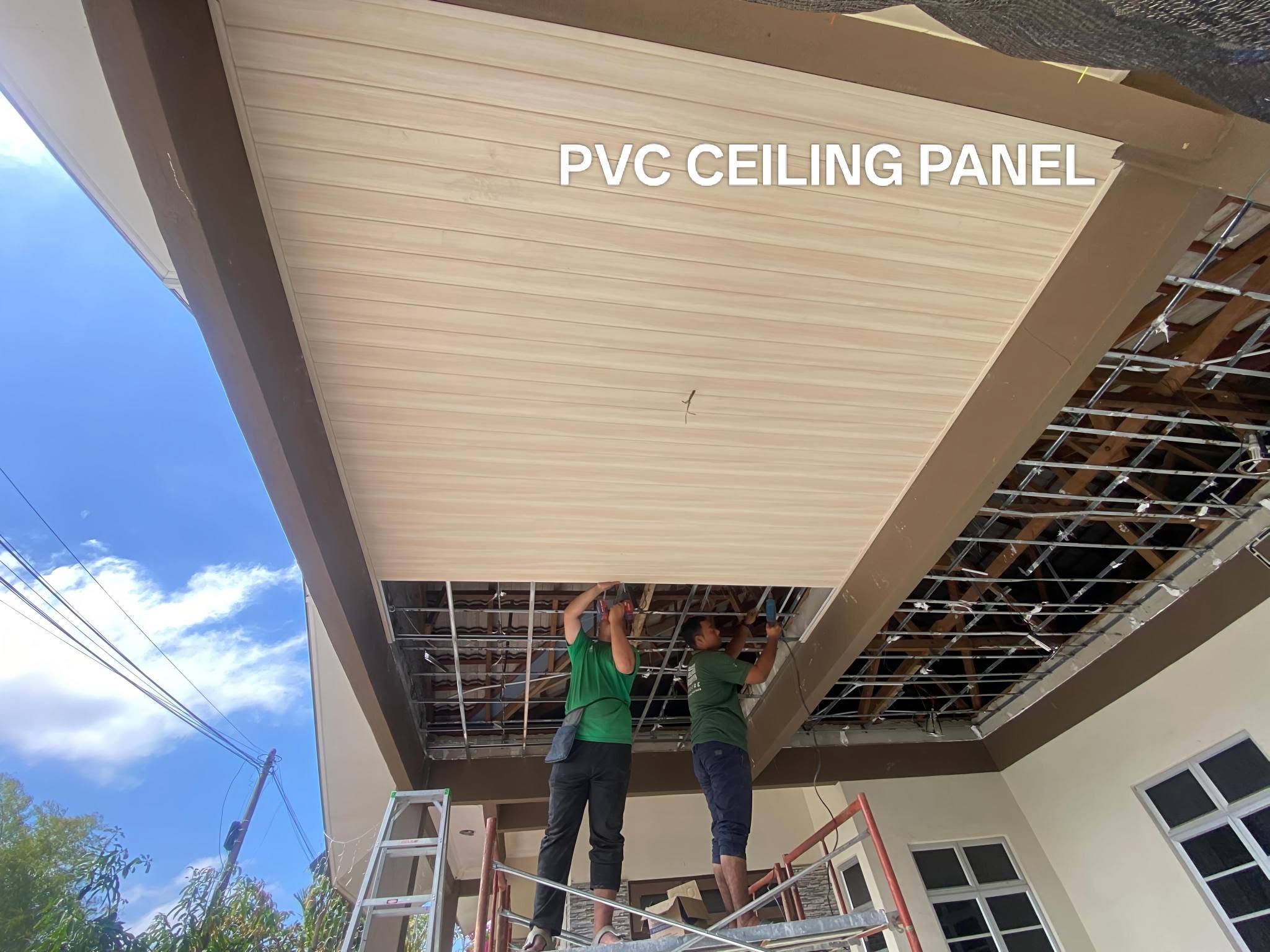
Distributors typically stock several panel families at once, so product names must be unambiguous on the order.
Download the product catalogue
The 2026 YIKE New Material catalogue lists the PVC ceiling panel, PVC wall panel, PVC marble sheet, WPC wall panel, outdoor WPC wall panel and self-adhesive sticker ranges with model codes: Download the 2026 YIKE New Material catalogue (PDF).
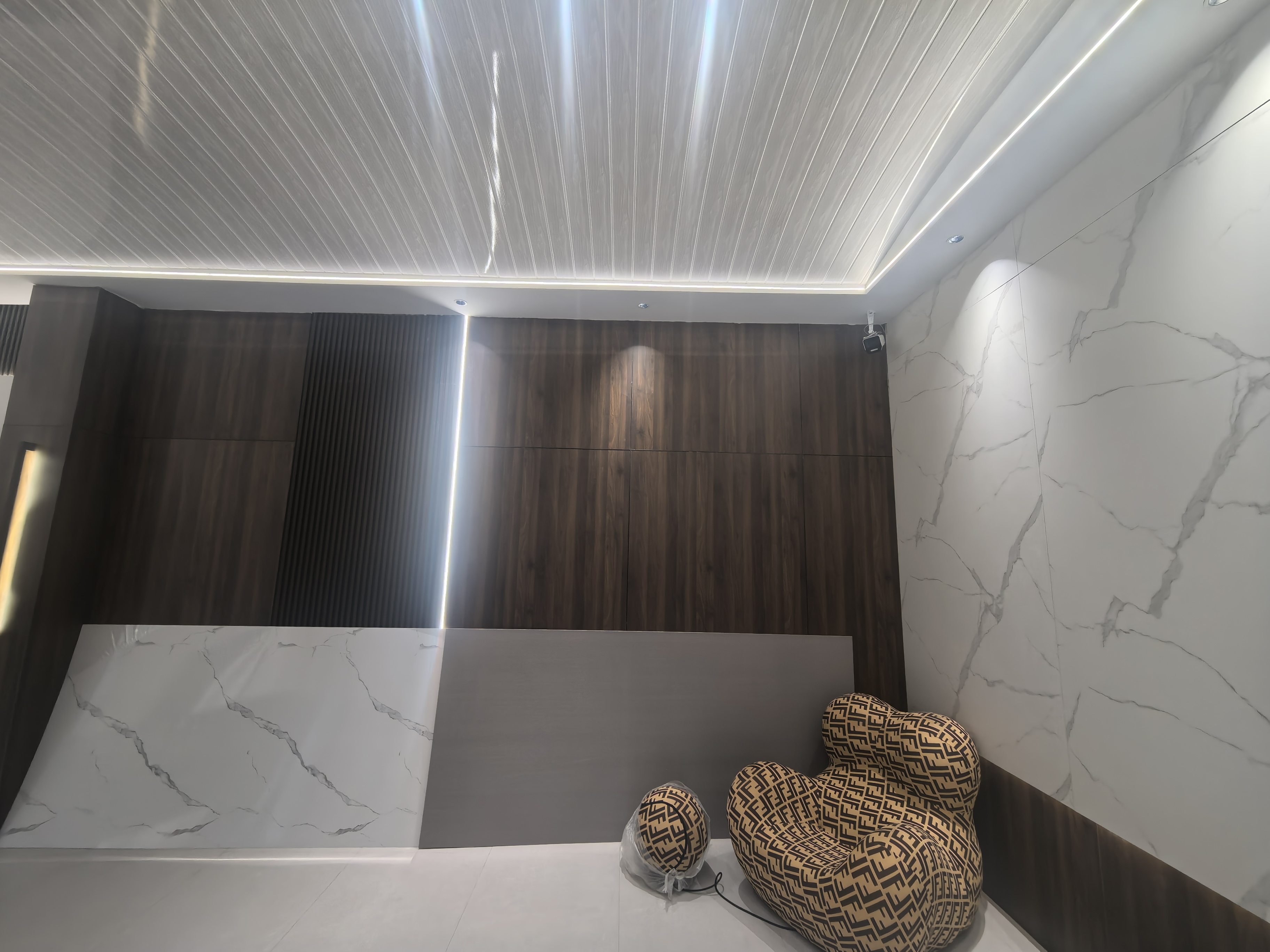
Catalogue codes and samples let a buyer confirm the product behind each name before ordering.
Frequently Asked Questions
Which fire performance should I verify before specifying PVC or WPC wall panels?
Ask for the test report that matches your market rather than a general claim. In North America, ASTM E84 (UL 723) is the reference fire test for interior wall and ceiling finishes, and Class A requires a Flame Spread Index of 0–25. In the EU, reaction to fire is classified under EN 13501-1, and Class B-s1, d0 is often the target for commercial PVC panel work. YIKE states that some of its models reach B1 flame retardant grade, so the specific model on your order should be confirmed against the standard your project applies.
Is a PVC marble sheet the same thing as a PVC wall panel?
No. A PVC marble sheet is a UV-coated board made from PVC resin and calcium carbonate, supplied in 1220 × 2440 mm or 1220 × 2800 mm formats at 2–3 mm thickness for interior feature walls. A PVC wall panel is rigid PVC wall cladding in strip form, and a PVC ceiling panel is the ceiling version of that cladding. Thickness, format, fixing method and joint treatment all differ, so one cannot substitute for the other in a specification.
Can indoor WPC wall panels be used outdoors?
No. YIKE's product guidance states that indoor WPC panel is not a replacement for outdoor WPC wall panel. Outdoor panels use a UV-resistant, weather-resistant formulation to resist sunlight, temperature change and rain, while indoor panels exposed on a façade will fade and crack quickly. Indoor WPC panels are intended for interior walls, including humid interiors such as basements and hotel bathrooms.
What does “fluted” mean in a WPC fluted wall panel?
Fluted describes the profile — a grooved or reeded face — not the material. A fluted wall panel can be produced in different substrates, so the line item should state WPC or PVC as well as the profile. YIKE's WPC wall panel profiles include widths of 150–200 mm, depths of 10–24 mm and a 2900 mm length, for example YK-160*20*2900mm and YK-200*20*2900mm. Confirm the profile code, flute depth and fixing method before ordering.
What is the minimum order quantity for YIKE decorative panels?
The MOQ is one 20-foot container with 4–6 colours from the E-catalogue. For smaller quantities, 500 m² per colour can be ordered from stock colours, or 1,000 m² per colour from the E-catalogue. The same terms apply across the PVC ceiling panel, PVC wall panel, PVC marble sheet, WPC wall panel and PVC self-adhesive wall sticker ranges.
How should I check a sample before confirming a panel order?
Match the sample to the exact name and grade in your specification. For rigid panels, check flatness, surface coating and colour consistency. For PVC self-adhesive stickers, test adhesion and removal on a dry wall surface and inspect printing clarity and backing release paper. For outdoor WPC panels, request the outdoor ageing report together with the sample. YIKE supplies pre-production samples and runs 100% pre-shipment testing, with third-party inspection by SGS available.
What is the lead time, and how do I start a mixed order across product types?
YIKE quotes a 14–30 day lead time with monthly capacity of 500,000 m² across its PVC and WPC lines. For a mixed order, list each wall or ceiling area against the product name — PVC ceiling panel for ceilings, PVC wall panel or WPC wall panel for walls, PVC marble sheet for feature surfaces and self-adhesive sticker for quick refresh — then request samples of each type before confirming quantities. The sales team can review drawings by area to match names to specification, and the catalogue PDF above lists the model codes.
Have Questions or Need More Details?
Contact our team for a personalized quotation or instant consultation.
Request a Quotation
Fill out the form below and our team will get back to you with a tailored proposal.
WhatsApp Direct Chat
Prefer to chat in real-time? Message us on WhatsApp for instant assistance & quick answers.
- Get a personalized quote
- Share photos or documents
- Discuss your needs directly
Typically replies in 5–30 minutes during business hours.