
PVC & WPC Panel Compliance Guide: Verifying Material Claims by Market and Project
PVC & WPC Panel Compliance Guide: Verifying Material Claims by Destination Market and Project Type
Short answer: a PVC or WPC panel is approved on documentation, not on description. Approval depends on whether the supplier's declared material composition and performance claims can be matched, in writing, to the destination market's requirements and to the conditions of the specific project — a dry interior wall, a humid ceiling, a retail feature wall, or an exterior facade. When those four elements are aligned and traceable, a shipment clears inspection. When one is missing, the claim stays unverified no matter how good the sample looked.
This guide is written for importers, distributors and project specifiers who already know which product family they want and now have to defend the specification to a customer, a consultant, a customs broker or a building owner. It sets out what to declare, what to request, what to check on site, and where the common claims — waterproof, UV-resistant, termite-proof, no-painting and 15–25-year service life — break down.
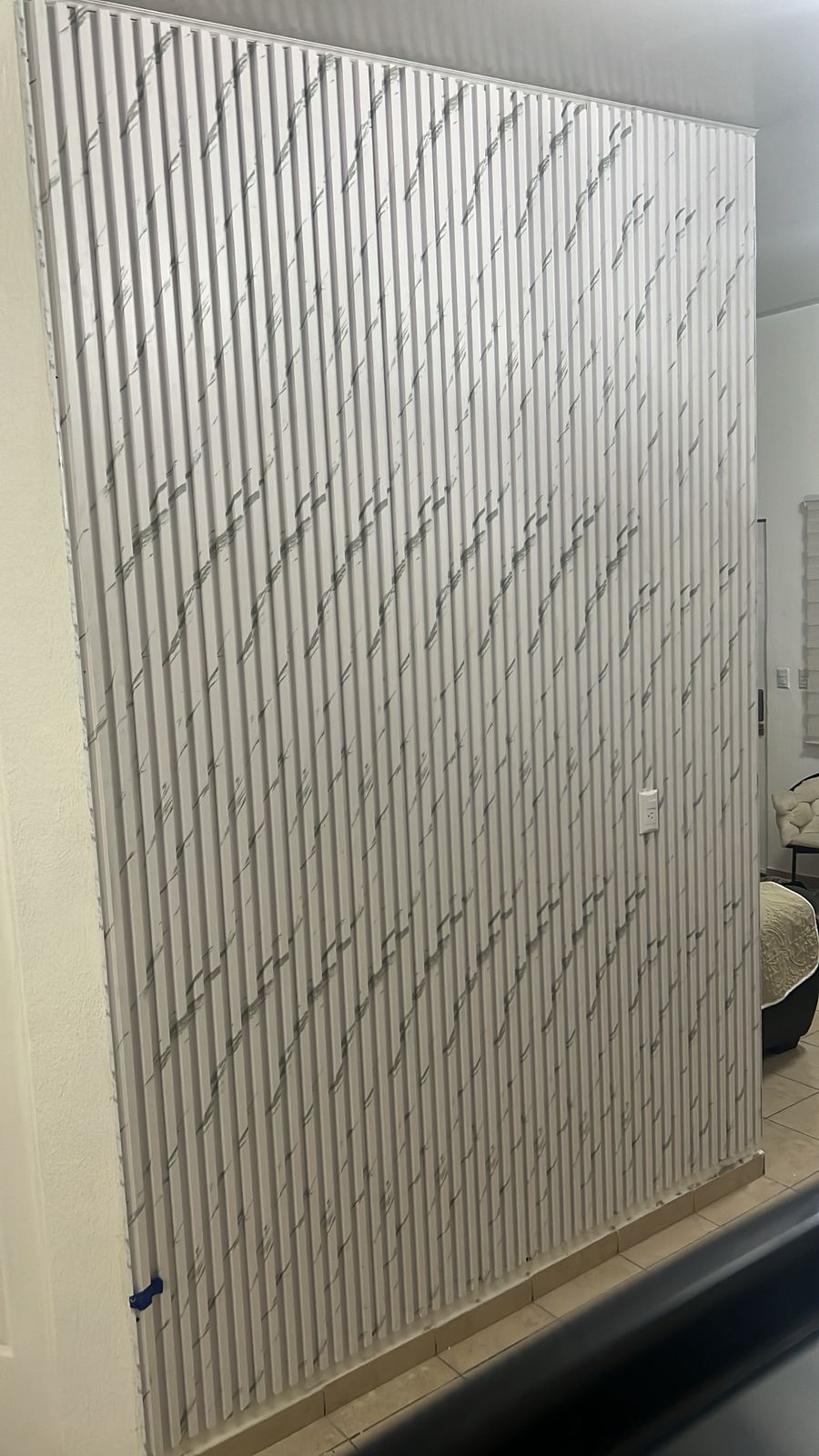
Installed PVC and WPC decorative panels in a destination market — the claim must match the room, not just the catalogue page.
The Problem: Claims Travel Faster Than Evidence
A quotation usually arrives with a short list of performance words — waterproof, UV-resistant, termite-proof, no painting needed, 15–25 years. Those words are not specifications. They are conclusions that only hold when the material composition, the test basis and the installation conditions are all stated. Most approval delays in decorative panel projects come from five recurring gaps:
- Claim transfer between product families. An indoor WPC panel cannot be substituted for an Outdoor WPC Wall Panel on a facade; the outdoor grade carries a UV-stabilised, weather-resistant formulation that resists sunlight, temperature change and rain erosion, while the indoor panel will fade and crack under the same exposure.
- Claims without scope. A waterproof statement that does not distinguish core water absorption from joint and edge sealing cannot be checked. A UV claim that does not say indoor anti-yellowing or outdoor weathering cannot be tested.
- Composition drift between sample and bulk. Filler load, resin grade, film thickness and top-layer type can change between a hand-made sample and a production batch unless they are written into the order.
- Documents that arrive after the container. Test reports, inspection records and declarations assembled after shipment cannot support a customs or consultant review.
- Market requirements discovered at the port. Destination requirements are set by the importing country's authority and by the buyer's contract — not by the supplier's catalogue — so they must be confirmed at quotation stage.
Industry Background: Why Panel Claims Are Harder to Verify Than They Appear
Decorative panels sit in an unusual position: they are specified like a construction material but traded like a consumer product. A single order can combine a ceiling panel, a marble-effect wall sheet, an indoor WPC profile and an adhesive sticker, each with a different material basis and a different set of claims. Verification therefore has to be done per model, not per supplier.
YIKE (Haining Yike New Material Co., Ltd.) is a China-based manufacturer and exporter of PVC and WPC decorative building materials, founded in 2019, operating a 10,000 m² factory with 50 employees and annual output of 5,000,000 m². Its product range covers PVC Ceiling Panel, PVC Wall Panel, PVC Marble Sheet, UV Marble Sheet, PVC Marble Wall Panel, WPC Wall Panel, WPC Fluted Wall panel, Outdoor WPC Wall Panel, PVC Decorative Panel and PVC Self-Adhesive Wall Sticker. All output is exported, with main markets in Central America, South America, Southeast Asia, the Middle East and Africa.
In those markets, the importer or the project specifier frequently carries the compliance decision rather than a local certification body. That changes the practical question from “do you have certificates?” to “what exactly does this document cover, for which model, under which test condition, and is it current?” A supplier that can answer that question model by model is easier to approve than one that answers with a logo.
The Four-Column Verification Model
Every panel claim can be closed out by reading it against four columns: Material, Claim, Market, Project. If any column is empty, the claim is not verified.
Column 1 — Material Composition, Declared per Product Family
Interior PVC panels — PVC Wall Panel, PVC Ceiling Panel, PVC Decorative Panel and PVC Marble Wall Panel — are generally built on a PVC resin base with calcium carbonate filler and an additive package of stabilisers, lubricants and colorants. The declaration that matters is not the material name but the ratios: filler load, virgin versus recycled resin, stabiliser system, and for film-faced panels the film thickness and bonding method. A high filler load can pass a visual check and still fail flatness, impact or fixing performance later, so ask for the composition statement in writing and keep it with the order.
PVC Marble Sheet and UV Marble Sheet add a UV-cured top layer over a PVC substrate. The claim does not sit in the core — it sits in that top layer, which carries the scratch, stain and colour-fastness expectations. YIKE's PVC Marble Sheet range is stated in 1220 × 2440 mm and 1220 × 2800 mm formats at 2 mm, 2.2 mm, 2.5 mm, 2.8 mm and 3 mm (YK-1220*2440*2mm through YK-1220*2440*3mm, and the matching YK-1220*2800 series). Fix the thickness step in writing before any claim is attached to the order.
WPC Wall Panel is a wood-plastic composite of wood fibre, HDPE and additives. Compared with a plain PVC panel, the composite gives higher density, stronger impact resistance, better mildew and moisture resistance and less deformation, which is why it is usually specified for humid interiors such as basements and hotel bathrooms. Declare the wood-to-plastic ratio, the polymer grade and whether the visible surface is a co-extruded layer. YIKE's WPC Wall Panel models are YK-160*20*2900mm, YK-160*24*2900mm, YK-150*10*2900mm, YK-168*24*2900mm, YK-150*15*2900mm and YK-200*20*2900mm.
Outdoor WPC Wall Panel is a separate specification, not a stronger grade of the indoor product. It adds a UV-stabilised, weather-resistant formulation, and the three items that decide whether the facade claim survives the first hot–cold cycle are the surface co-extrusion layer, the anti-UV package and the thermal expansion allowance.
PVC Ceiling Panel models from YIKE are YK-200*6mm, YK-200*7mm, YK-200*8mm, YK-250*7mm, YK-250*7.5mm, YK-250*8mm, YK-300*8mm, YK-300*9mm and YK-400*8mm. The declaration should state thickness, weight per square metre and the moisture and mildew position, because ceiling panels in kitchens and bathrooms are judged on exactly that.
PVC Self-Adhesive Wall Sticker is adhesive-fixed rather than mechanically fixed. The claims needing evidence are adhesive strength, residue-free removal and anti-yellowing, plus the wall condition the adhesive requires: flat, clean, dry and dust-free. A sticker applied to a damp or powdery wall will blister regardless of adhesive quality — that is an installation failure, not a material failure, and the two should be separated in the acceptance document so a site issue is not automatically treated as a product claim.
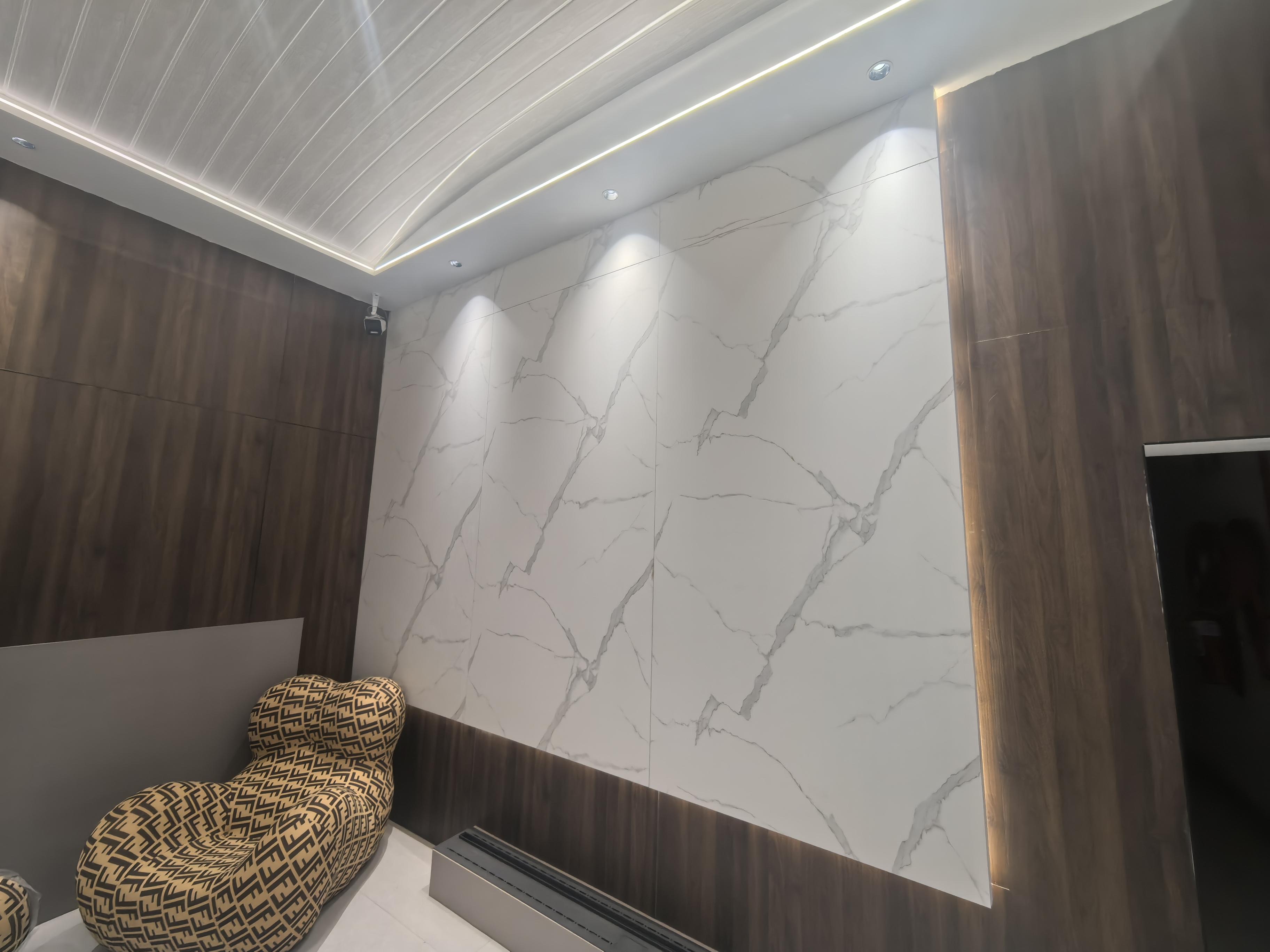
Tropical-climate application in Indonesia — moisture and colour-fastness claims carry more weight than impact claims here.
Column 2 — Turning Performance Claims into Evidence
Waterproof. Split the single word into three statements: the core does not absorb water; the installed system resists ingress at joints and edges; the panel tolerates the specific wet area. PVC marble sheet is moisture-proof and can be used in dry and wet indoor areas such as bathrooms, provided continuous soaking is avoided during installation and use. A self-adhesive sticker is not recommended in a shower zone that receives continuous water contact; long-term immersion causes edge warping and peeling. Approve the statement that matches the zone, and delete the ones that do not.
UV-resistant. Two different claims hide under this term. The indoor claim is anti-yellowing under interior light and heat. The outdoor claim is colour and mechanical retention under sunlight, rain and temperature cycling. Outdoor grade WPC uses UV-stabilised raw materials specifically to slow colour fading, and a slight natural colour change after years of exposure is normal behaviour rather than a defect — but that statement applies to the outdoor grade, not to an indoor panel installed outdoors.
Termite-proof. For a WPC panel, which contains wood fibre, a bio-resistance claim should be tied to the formulation and to a test basis. For an all-PVC panel the accurate wording is narrower: the panel is not a food source for termites. Accepting one sentence for both product families is the most common way this claim becomes unverifiable.
No-painting. This is a finish claim, not a material claim. It means the decorative surface holds its colour and pattern without a topcoat, and it should be tied to the surface system — UV-cured layer, printed film or co-extruded layer — plus a colour-fastness reference, not to a photograph of a showroom wall.
15–25-year service life. A service-life figure is a calculated estimate, not a property of the sheet. It is usable only if the supplier states the basis: which test, which climate assumption, which fixing method and which maintenance regime. Ask for the assumptions in writing. If the basis is missing, remove the number from the quotation and keep the material specification — a specification-driven order is far easier to defend than a promise-driven one.
Column 3 — Destination Market Documentation
No supplier should be assumed to hold a certification that has not been shown. The practical approach is to assemble the document set per shipment, per model, before loading:
- Composition declaration for each model and colour batch, naming resin or wood-plastic basis, filler or fibre content and additive package.
- Test reports stating the standard applied, the test scope, the sample identity and the date.
- Inspection record — YIKE's acceptance criterion is a pre-shipment test, and third-party inspection (SGS) is available.
- Commercial documents consistent with the declared specification: model code, thickness and quantity must match the declaration, since a packing list that disagrees with the declared specification is a common trigger for a hold.
- Labelling and language requirements for the destination market, confirmed with the buyer at quotation stage.
Verification rule: if a document cannot be produced for a specific model, treat the claim as unverified and re-scope the order. Do not accept a document issued for a different model, a different thickness or a different colour batch as coverage for the shipment in front of you.
Column 4 — Project Type and Zone Matching
Project type decides which claims are load-bearing. A dry interior feature wall is mostly a colour and flatness question. A bathroom or basement is a moisture and mildew question. A ceiling is a weight, fixing and humidity question. A commercial retail interior is a batch colour-consistency and impact question. A facade is a weathering and thermal-movement question.
The matching rule is simple: indoor WPC cannot replace outdoor WPC for an exterior facade, and PVC marble sheet is not recommended for long-term outdoor use because prolonged UV exposure causes surface fading and ageing. Panels that are correct for one zone and wrong for another are the most expensive kind of compliance error, because they usually fail after installation.
Step-by-Step: Verifying a PVC or WPC Panel Before Approval
- Fix the product family and model first. Nothing else can be verified against a category. Choose the model code — for example YK-250*7mm for a PVC Ceiling Panel or YK-160*20*2900mm for a WPC Wall Panel — and record it on the enquiry.
- Request a composition declaration per model. Resin or wood-plastic basis, filler or fibre content, additive package, top-layer type and thickness. Keep it attached to the purchase order, not to a separate brochure file.
- Map each claim to a test basis and a scope. Waterproof, UV, termite, no-painting and service life each need a stated condition. Any claim that cannot be scoped should be removed from the specification rather than softened in wording.
- Match the document set to the destination market. Confirm with the buyer which declarations, test reports and labelling the importing country requires, and confirm who is responsible for each document.
- Match the specification to the project zone. Dry wall, wet area, ceiling, high-traffic commercial and exterior facade each get a different claim priority. Record the zone in the order, because it is the argument that protects both sides if a panel underperforms.
- Validate on a sample and define acceptance criteria. The sample must come from the model and colour family being ordered. Agree in writing what is measured at acceptance — thickness, flatness, colour match, surface condition — and set the acceptance criterion as a pre-shipment test, with third-party inspection (SGS) where the buyer requires it.
- Lock the OEM/ODM details. YIKE supports OEM/ODM with customisation of colour, pattern and logo, backed by a 10-engineer R&D team, annual output of 5,000,000 m² and monthly capacity of 500,000 m². Colour, pattern, logo, packaging and batch colour calibration should be fixed before the declaration documents are issued, because the declaration follows the model and the batch, not the product family.
- Confirm commercial terms and support. Minimum order quantity, delivery terms and payment terms belong in the same approval file as the technical documents, so that a specification change cannot quietly move the commercial basis. After-sales support is provided as remote technical support.
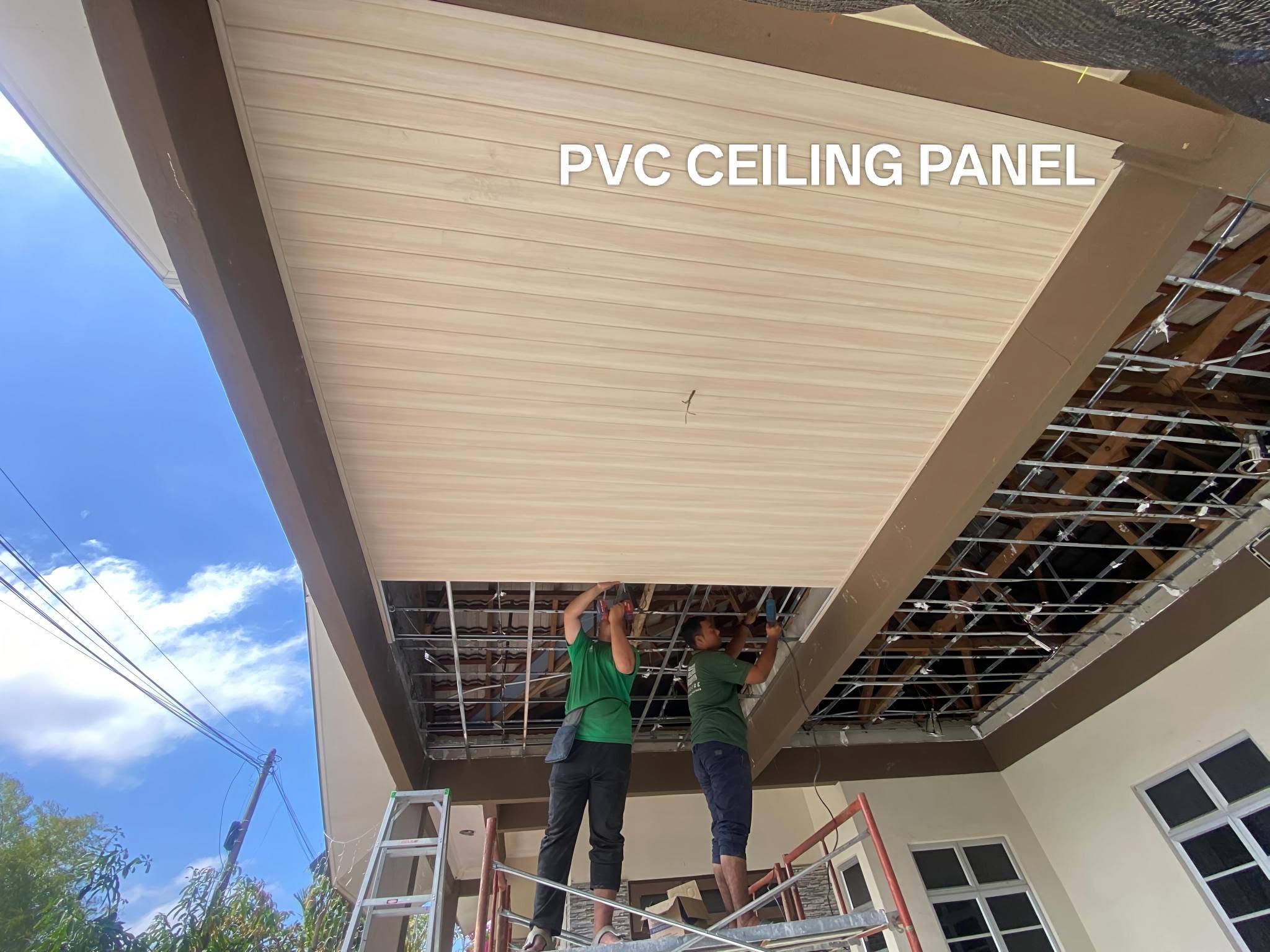
Distributor stock for residential projects in Malaysia — repeat orders depend on batch-to-batch consistency of the declared specification.
Use Cases: How the Checks Change by Project
Commercial retail interiors — Ecuador. A building materials distributor in Ecuador has taken 3 × 40HQ containers over a 2-year relationship, applying PVC Ceiling Panels, PVC Marble Sheets and WPC Wall Panels across retail shops, brand stores, showrooms, offices and restaurants. In this mix the load-bearing checks are batch colour consistency across containers and surface durability in high-traffic areas, because the visual result is the customer's brand. The marble-sheet top layer and the WPC surface layer both need to be specified, not assumed.
Residential renovation — El Salvador. A 1 × 40HQ container over 3 years of residential work, using PVC Ceiling Panels, PVC Marble Sheets and WPC Wall Panels. Residential approval is usually driven by moisture behaviour in kitchens and bathrooms and by flatness after installation, so the humidity claim and the fixing method carry more weight than impact resistance.
Tropical climate, continuous supply — Indonesia. A renovation service provider has imported 10 × 40HQ containers over 3 years, combining PVC Ceiling Panels, PVC Marble Sheets and WPC Wall Panels across residential and commercial interiors. In tropical conditions the UV and anti-yellowing position for indoor product, the mildew resistance of WPC and the consistency of the declared composition across repeat batches are the items that determine whether a long-term supply relationship holds.
Volume residential distribution — Malaysia. 10 × 40HQ containers over 2 years, with decorative panels installed in more than 100 residential houses and continuing to be selected for new renovation work. At this volume the compliance question shifts from single-order documents to batch traceability: the same model must behave the same way in container three as in container one.
High-frequency procurement — Colombia. More than 60 × 40HQ containers per year for a building materials distributor, covering PVC Ceiling Panels, PVC Marble Sheets, WPC Wall Panels and related decorative products. At this cadence, the working method is a standing document set that is refreshed rather than rebuilt for each order, with every model and every colour batch traceable to a declaration.
Comparison Tables
| Product family | Document to request first | Claim most often disputed | Project-condition check |
|---|---|---|---|
| PVC Ceiling Panel | Composition declaration plus thickness and weight per m² | Moisture and mildew resistance | Humidity of the room above and below the ceiling |
| PVC Wall Panel / PVC Decorative Panel | Composition declaration plus surface film specification | Surface adhesion and anti-yellowing | Interior light exposure and cleaning regime |
| PVC Marble Sheet / UV Marble Sheet | Top-layer type plus substrate thickness | Scratch and colour-fastness of the UV layer | Indoor use only; avoid long-term outdoor exposure |
| WPC Wall Panel (indoor) | Wood-to-plastic ratio and polymer grade | Moisture-proof and mildew behaviour | Basements, bathrooms and other humid interiors |
| Outdoor WPC Wall Panel | UV-stabilised formulation plus co-extrusion layer | Weather resistance and colour retention | Facade exposure, thermal movement, drainage |
| PVC Self-Adhesive Wall Sticker | Adhesive and release-paper specification | Residue-free removal after service life | Flat, dry, dust-free wall; not a continuous-water zone |
| Claim | Evidence that converts it into a verified statement | What invalidates it |
|---|---|---|
| Waterproof | Core water-absorption statement plus joint and edge sealing method | Claim applied to a continuously immersed zone |
| UV-resistant | Separate indoor anti-yellowing and outdoor weathering statements with reference conditions | Indoor grade used on an exterior facade |
| Termite-proof | Formulation-linked statement with a test basis for wood-fibre content | Identical wording applied to PVC and WPC families |
| No-painting | Surface system identified plus colour-fastness reference | Claim resting on a photograph or showroom sample |
| 15–25-year service life | Written assumptions: test basis, climate, fixing method, maintenance | Number quoted with no stated basis |
Frequently Asked Questions
What documents should an importer request before approving a PVC or WPC panel shipment?
Request a composition declaration per model, test reports that state the standard, the test scope, the sample identity and the date, and an inspection record covering the actual shipment. YIKE's acceptance criterion is a pre-shipment test, and third-party inspection (SGS) can be arranged where the buyer requires it. Add the commercial documents — model code, thickness and quantity — and confirm they match the declaration, because a mismatch between packing list and declared specification is a common cause of a hold. If a document cannot be produced for a specific model, the claim for that model should be treated as unverified rather than assumed from another product in the same range.
Can an OEM PVC panel manufacturer support custom wall and ceiling projects?
Yes, provided the customisation scope and the model range are defined before the order. YIKE operates OEM/ODM production with customisation of colour, pattern and logo, supported by a 10-engineer R&D team, annual output of 5,000,000 m² and monthly capacity of 500,000 m², across wall and ceiling formats including PVC Ceiling Panel models YK-200*6mm to YK-400*8mm and WPC Wall Panel models from YK-150*10*2900mm to YK-200*20*2900mm. The important discipline is sequencing: fix model, thickness, colour and packaging first, then issue the declaration documents, because those documents follow the model and the batch — not the product family name.
What are the minimum order quantity, delivery terms and payment terms?
The MOQ is one 20' container with 4–6 colours from the E-catalog. If your quantity is less than one container, you can choose 500 m² per colour from stock colours or 1,000 m² per colour from the E-catalog. Delivery terms are FOB, CIF or CFR, and payment terms are 30% T/T in advance with 70% T/T against a copy of the B/L. Because these terms sit in the same approval file as the technical declaration, any specification change should be re-confirmed against them before production starts.
How should samples and pre-shipment acceptance be handled?
Sample approval should come before the bulk order, and the sample must come from the model and colour family actually being ordered — a sample from a different thickness or a different batch proves nothing about the shipment. Agree in writing what is checked at acceptance: thickness, flatness, colour match and surface condition. YIKE applies 100% pre-shipment testing and can support third-party inspection (SGS). Buyers who want to run this check on their own specification can request a sample together with the current YIKE New Material catalogue, which lists the model ranges and formats, and compare the declared values against the physical sample before the order is released.
What lead time applies to a custom PVC or WPC panel order?
Production lead time is 14–30 days, with remote technical support provided after delivery. The usable planning sequence is: confirm the specification and the document set, approve the sample, release production, complete the pre-shipment test or third-party inspection, then ship. Buyers who compress that sequence usually lose the time again at inspection, so the document set should be agreed at quotation stage rather than after the container is booked. For current model lists, formats and terms, the YIKE New Material catalogue can be downloaded here: YIKE New Material catalogue (PDF), and specific compliance questions can be sent to sales@merchandise-eco.com.
Conclusion: Approve the Evidence, Then Approve the Panel
Material claims on PVC and WPC panels are not difficult to verify — they are just rarely verified in the right order. Fix the model, get the composition declared, scope every claim to a test basis, match the document set to the destination market, and match the specification to the project zone. That sequence turns a list of marketing words into a defensible specification, and it protects the importer at customs, the specifier at handover and the distributor at the third repeat order.
Haining Yike New Material Co., Ltd. (YIKE NEW MATERIAL) manufactures and exports PVC Ceiling Panel, PVC Wall Panel, PVC Marble Sheet, UV Marble Sheet, PVC Marble Wall Panel, WPC Wall Panel, WPC Fluted Wall panel, Outdoor WPC Wall Panel, PVC Decorative Panel and PVC Self-Adhesive Wall Sticker from a 10,000 m² facility in Haining, Zhejiang, China, founded in 2019, with 50 employees, a 10-engineer R&D team and 5,000,000 m² annual output.
Next Step
Send the model code, destination market and project zone, and YIKE will return the matching composition declaration, available test documentation and the commercial terms for that model — so the approval file is complete before the order is placed.
Email: sales@merchandise-eco.com | Tel / WhatsApp: +86 188-5830-7787 | Website: www.merchandise-eco.com
Address: Room 1315, NO. 273 Haining Avenue, Haizhou Street, Haining, Jiaxing City, Zhejiang Province, China
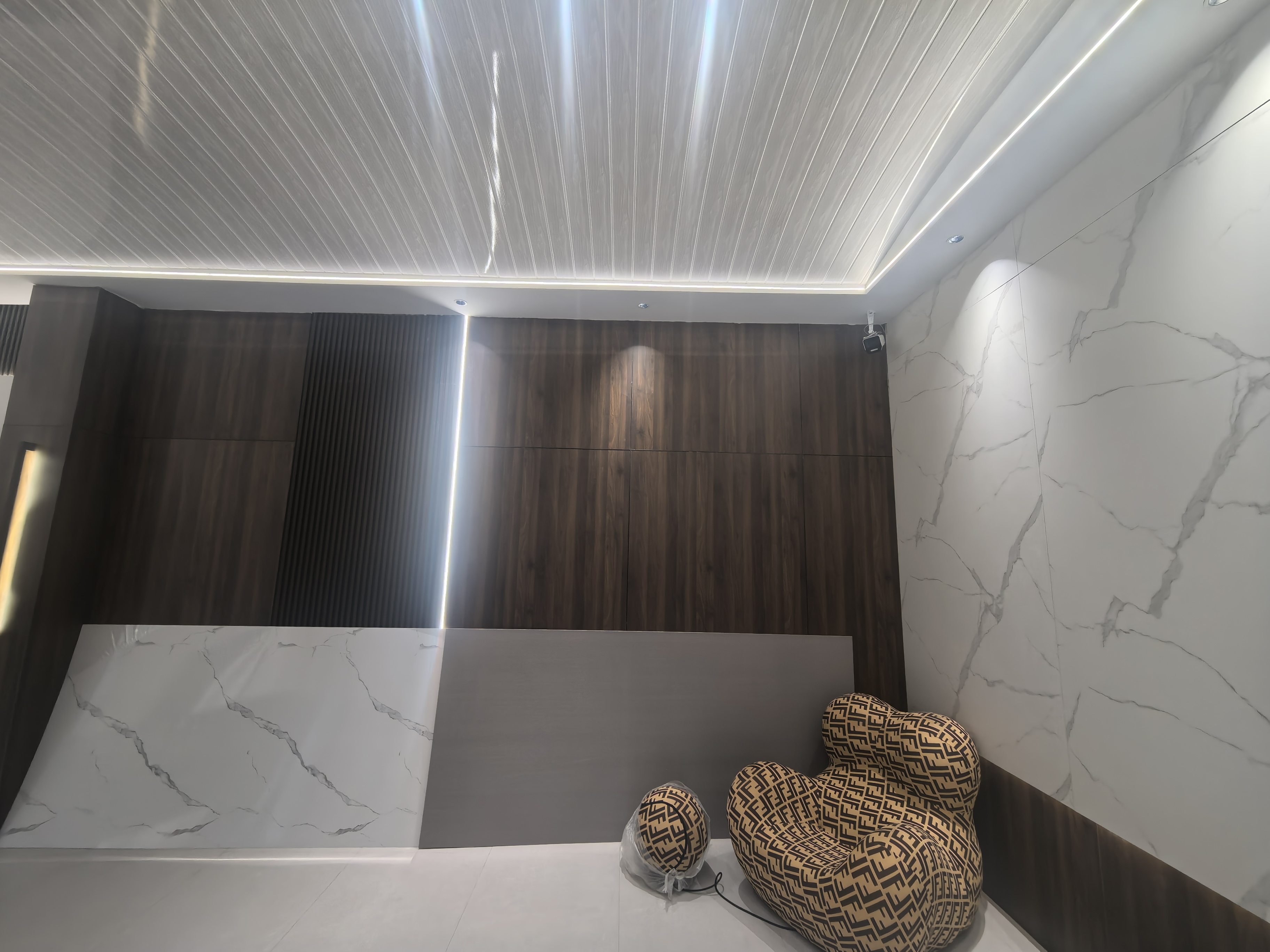
Distributor and wholesaler supply programme — documented per model, per batch, per destination market.
Have Questions or Need More Details?
Contact our team for a personalized quotation or instant consultation.
Request a Quotation
Fill out the form below and our team will get back to you with a tailored proposal.
WhatsApp Direct Chat
Prefer to chat in real-time? Message us on WhatsApp for instant assistance & quick answers.
- Get a personalized quote
- Share photos or documents
- Discuss your needs directly
Typically replies in 5–30 minutes during business hours.