
Evaluating PVC Panel Suppliers: A Line-by-Line Capability Check
Most PVC panel sourcing decisions fail at the first step, not the last. The buyer assumes that a supplier quoting PVC wall panels also extrudes ceiling profiles, coats marble sheets, produces interior WPC fluting, manufactures outdoor WPC cladding and converts self-adhesive wall sticker — because one catalogue shows all six. Those products belong to the same decorative building materials family, but they are not made on one line, in one format, or to one tolerance.
A capability check therefore has to come before a price comparison. The useful question is not whether a supplier sells PVC panels, but which of the six lines it actually manufactures, which model designations and formats prove that, and which specification it will commit to in writing. This guide converts that question into a verification sequence a distributor, importer or project buyer can run during the research stage, before any deposit is discussed.
Why the One Supplier, Six Lines Assumption Fails First
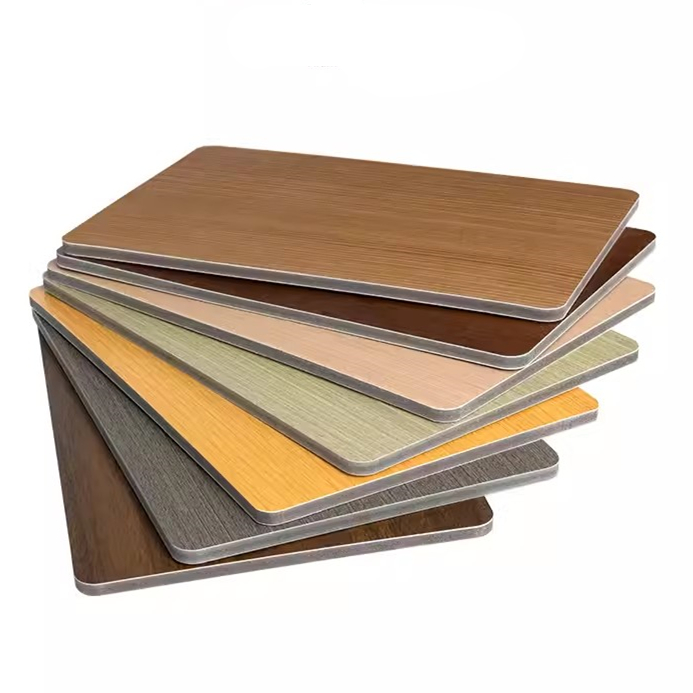
Catalogues flatten technical differences. PVC wall panel at 5 mm or 8 mm and PVC marble sheet at 2.0–3.0 mm are rigid decorative sheet, produced in 1220 × 2440 mm and 1220 × 2800 mm formats. PVC ceiling panels are extruded profiles from 200 mm to 600 mm wide and 6 mm to 10 mm thick. Interior WPC fluted panels are extruded profiles such as 160 × 20 × 2900 mm or 200 × 20 × 2900 mm. Outdoor WPC wall panels are a heavier profile family built around widths of 140 mm to 219 mm, with a popular 219 × 26 mm section. PVC self-adhesive wall sticker is a converted roll product, 2.5 mm thick, 600 mm or 1200 mm wide and 3 m long.
Because the formats differ, so do the failure modes. Sheet lines fail on flatness and coating adhesion. Ceiling profiles fail on rib rigidity and PVC content. Fluted WPC panels fail at clip engagement. Outdoor profiles fail on UV stability and colour retention. Sticker fails on adhesive behaviour and residue on removal. One approval sample taken from one line therefore proves nothing about the other five, and a supplier that is strong on sheet may be reselling profiles.
For the buyer, the practical consequence is that a single price list covering six products hides three separate questions: who sets the specification, who inspects it, and who is accountable when the second container does not match the first.
What the Decorative Panel Supply Base Looks Like
YIKE NEW MATERIAL (Haining Yike New Material Co., Ltd.) is a China-based manufacturer and exporter of PVC and WPC decorative building materials, operating from Haining, Jiaxing City, Zhejiang Province, with a 10,000 m² factory, 50 employees, a 10-engineer R&D team and an annual output of 5,000,000 m². The company was founded in 2019 and exports 100% of its production, with main markets in Central America, South America, Southeast Asia, the Middle East and Africa.
Its product range covers PVC Ceiling Panel, PVC Wall Panel, PVC Marble Sheet, UV Marble Sheet, PVC Marble Wall Panel, WPC Wall Panel, WPC Fluted Wall Panel, Outdoor WPC Wall Panel, PVC Decorative Panel and PVC Self-Adhesive Wall Sticker. That breadth is exactly why a buyer should not accept it as a single claim: each line has its own size envelope, material base and finish range, and each can be pinned to a model designation.
The commercial logic behind broad ranges is straightforward. Importers serving renovation-driven markets rarely buy one product in isolation — a single container usually mixes ceiling panels for wet areas, wall panels or marble sheet for feature surfaces, fluted WPC for corridors and sticker for fast touch-ups. A supplier that can build that mix shortens the buying cycle; a supplier that cannot forces the buyer to coordinate several factories, several inspection points and several shipment dates.
The Six Lines You Need to Verify Separately
1. PVC Wall Panel
PVC wall panel is a rigid decorative sheet made from PVC, calcium carbonate and additives. The standard size is 1220 × 2440 mm, with 1220 × 2800 mm or customized sizes available, and thickness options of 5 mm and 8 mm reflected in model designations such as YK-1220*2440*5mm, YK-1220*2440*8mm, YK-1220*2800*5mm and YK-1220*2800*8mm. Pattern options cover marble, wood grain, fabric, stone and metal, and installation can use glue, aluminium profile or hidden fixing. OEM and ODM are supported.
Verification focus: because these panels are wide-format, flatness and surface film bonding matter more than on narrow profiles. Ask which thickness corresponds to which model and whether the 1220 × 2800 mm format is produced or only quoted.
2. PVC Ceiling Panel
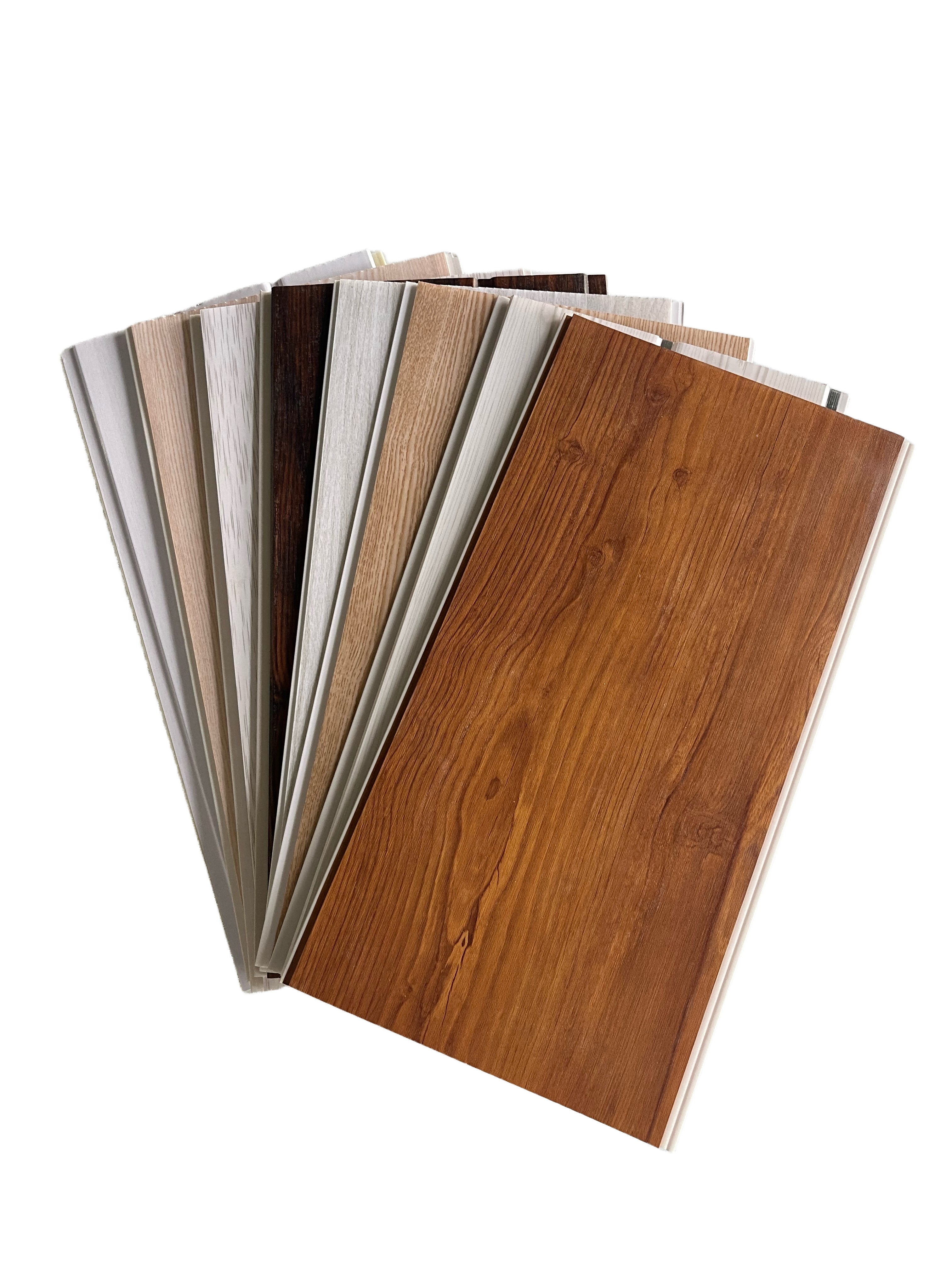
PVC ceiling panel is an extruded profile made from PVC resin, calcium carbonate and additives, offered in widths of 200 mm, 250 mm, 300 mm, 400 mm and 600 mm, thickness from 6 mm to 10 mm, and lengths of 2900 mm, 2950 mm, 3950 mm, 5800 mm, 5950 mm or customized. Model designations run from YK-200*6mm through YK-400*8mm. Surface finishes include printing, hot stamping and laminated, and packaging can be PE film or carton, with customized packaging available. OEM and ODM are available.
Verification focus: PVC content is stated as 35%–50% and is customizable. That single variable changes weight, rigidity and price, so it belongs on the quotation line — not buried in a general product description.
3. PVC Marble Sheet and UV Marble Sheet
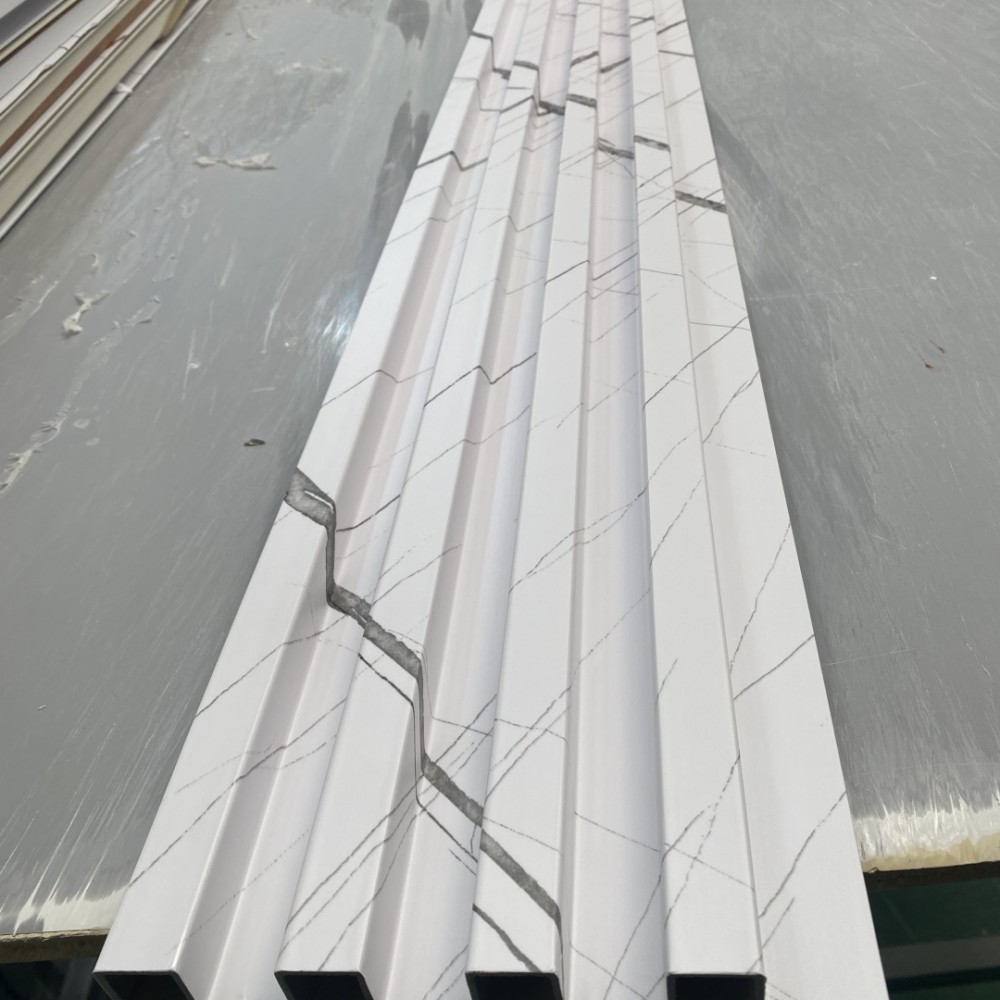
PVC marble sheet, also supplied as UV marble sheet and PVC marble wall panel, is made from PVC resin, calcium carbonate and additives with a UV coating or high gloss coating. Standard size is 1220 × 2440 mm, with 1220 × 2800 mm or customized options, and thickness of 2.0 mm, 2.2 mm, 2.5 mm, 2.8 mm or 3.0 mm. Surface finish options are high gloss, matte and embossed, with marble, wood and golden patterns. The product is described as 100% waterproof, installed with glue, silicone or aluminium profile, and available for OEM and ODM.
Verification focus: thickness and finish type are the two variables that buyers most often compare wrongly, because a high gloss 2.0 mm sheet and an embossed 3.0 mm sheet are not interchangeable. Note also that this is an interior product — long-term outdoor exposure is not recommended.
4. WPC Wall Panel (Interior Fluted)
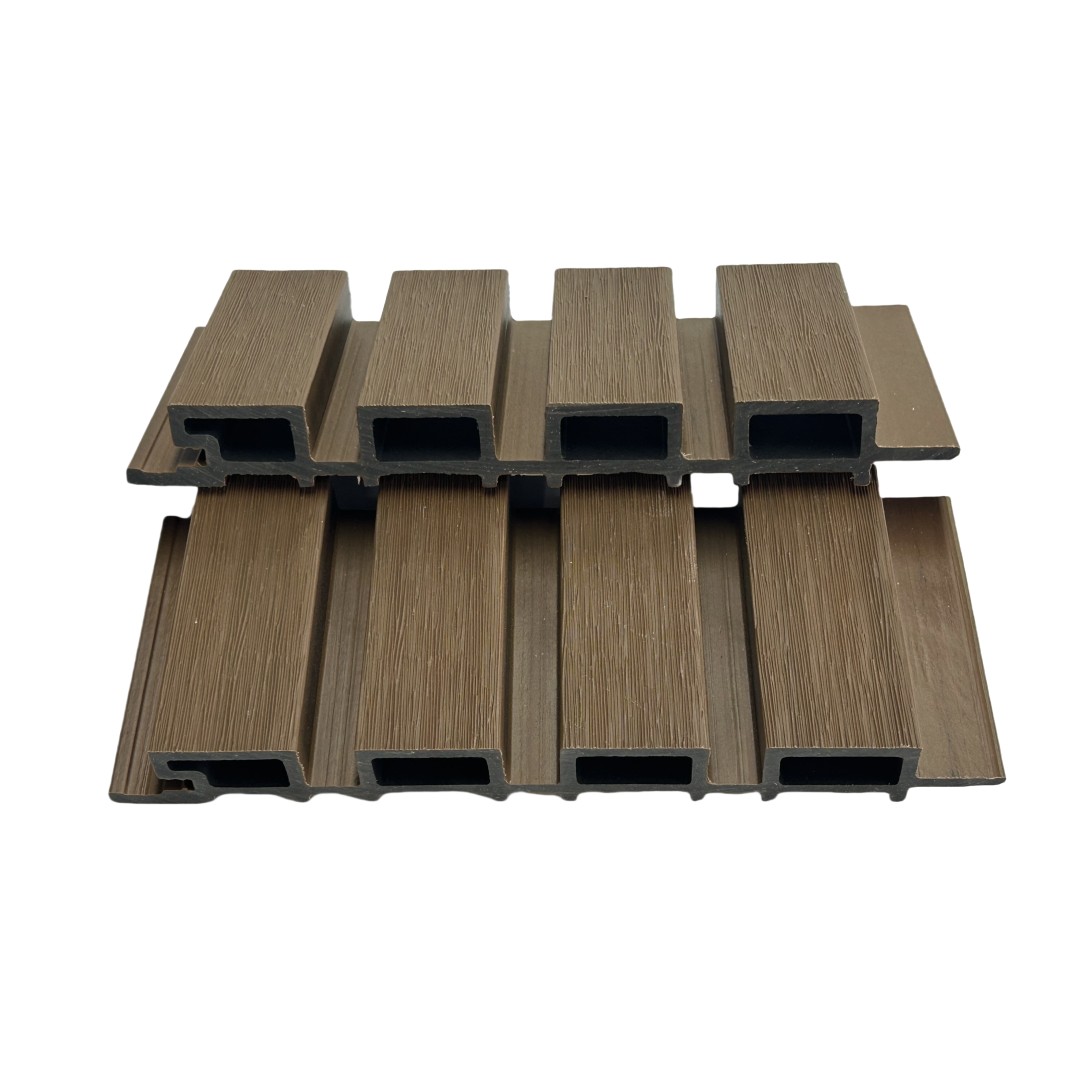
Interior WPC wall panel, including the WPC fluted wall panel format, is a wood-plastic composite built from PVC or PE plus wood fibre and additives. Popular models are 160*20*2900mm, 160*24*2900mm, 150*10*2900mm, 168*24*2900mm, 150*15*2900mm and 200*20*2900mm. Installation uses clips, screw fixing or glue. Colours include walnut, oak, teak, black, grey and natural wood, with customization available, and OEM and ODM are available.
Verification focus: the model designation already encodes width, thickness and length, so it can be checked against the sample without interpretation. Clip engagement and colour consistency across a batch are the practical acceptance points.
5. Outdoor WPC Wall Panel
Outdoor WPC wall panel uses wood fibre, HDPE and additives, and is produced as either co-extrusion WPC wall panel or traditional WPC wall panel. Widths are 140 mm, 145 mm, 177 mm and 219 mm, thickness 13 mm, 20 mm or 26 mm, length 2.9 m or customized, with a popular size of 219*26mm shown in designations such as YK-219*26*2900mm, YK-140*20*2900mm, YK-145*20*2900mm, YK-177*13*2900mm, YK-201*25*2900mm, YK-100*50*2900mm and YK-50*50*2900mm. Surface finishes include wood grain, brushed, sanded, embossed and 3D wood texture, with colours spanning chocolate, brownish red, orange, black, light grey, green, original wood, dark grey and customized shades. Service life is stated at 15–25 years, and OEM and ODM are available.
Verification focus: co-extrusion and traditional construction must be stated explicitly, because the two behave differently outdoors. Interior WPC cannot be substituted for exterior cladding, and outdoor grades use UV-stabilised raw materials to slow colour change under sunlight.
6. PVC Self-Adhesive Wall Sticker
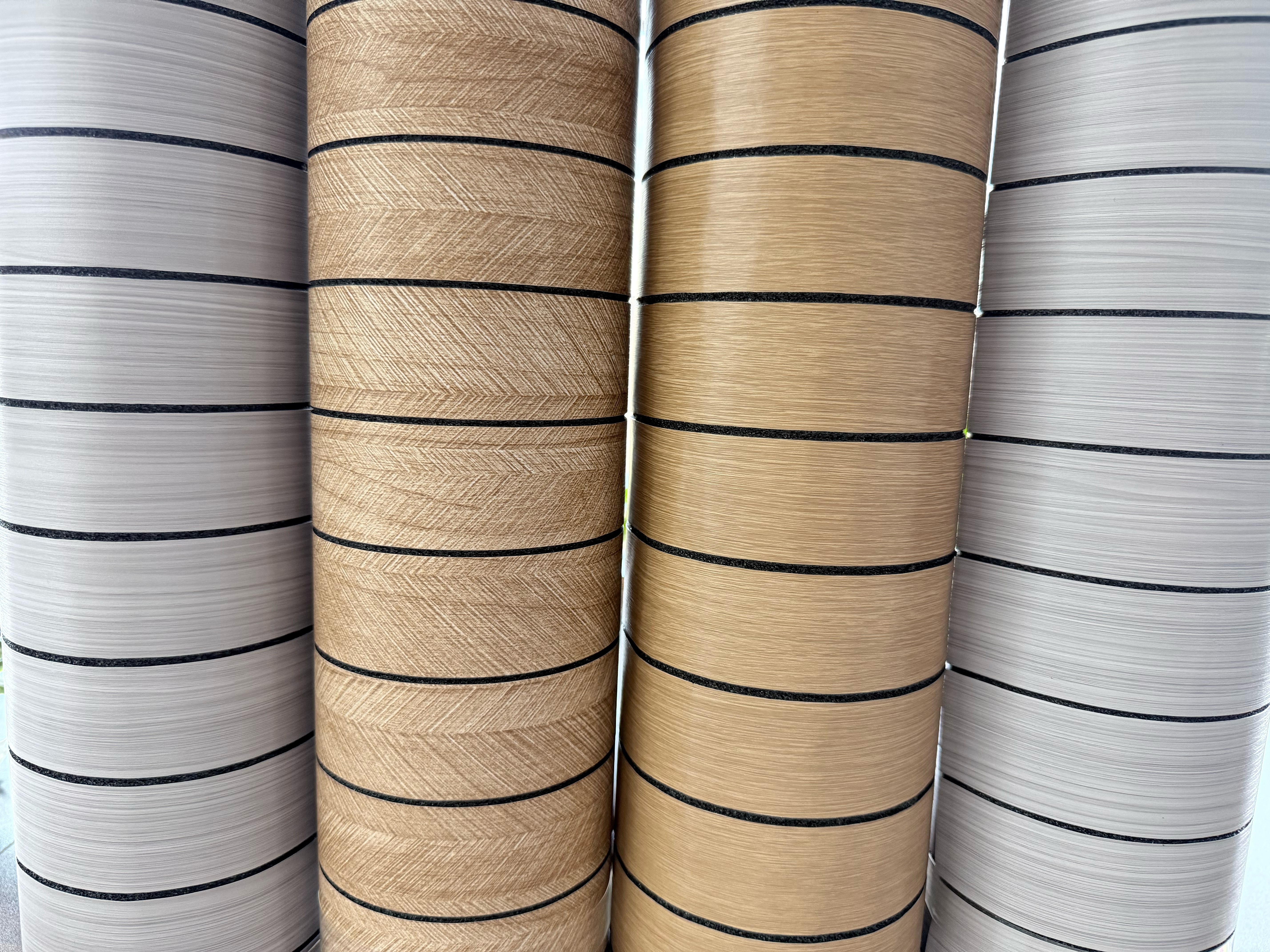
PVC self-adhesive wall sticker is a PVC roll product at 2.5 mm thickness, 600 mm or 1200 mm width and 3 m roll length, with glossy, matte and embossed surface finishes and patterns covering marble, wood grain, stone, concrete, brick, tile, solid colour and floral. Model designations include YK-1200*3000mm and YK 600*3000mm, indoor service life is stated at 5–10 years, and OEM and ODM are supported.
Verification focus: this is an adhesive product, so the checks change. Adhesive viscosity, backing release paper quality and residue behaviour on removal matter more than panel rigidity, and installation requires a flat, clean, dry wall. Continuous water contact, such as a shower zone, is not recommended.
How to Run a Six-Step Capability Check
The sequence below works because each step produces a written answer that can be attached to a purchase order later. It does not require a factory visit, although a visit confirms what paperwork already shows.
Step 1 — Request a line list with model designations, not a catalogue
Ask the supplier to list the lines it manufactures and to attach at least one model designation per line, for example YK-1220*2440*5mm for wall panel, YK-300*8mm for ceiling panel, YK-160*20*2900mm for interior fluted WPC, YK-219*26*2900mm for outdoor WPC and YK-1200*3000mm for sticker. A catalogue page cannot be verified; a model designation can.
Step 2 — Match each line to a production format
Classify every line as rigid sheet, extruded profile or converted roll. Sheet lines cover 1220 × 2440 mm and 1220 × 2800 mm formats. Profile lines cover ceiling panels at 200–600 mm width and WPC profiles such as 160 × 20 mm or 219 × 26 mm. Roll lines cover sticker at 600 mm or 1200 mm by 2.5 mm by 3 m. A supplier that presents all three formats with consistent model logic is describing production, not just distribution.
Step 3 — Lock size and thickness ranges in writing
Confirm the specific envelope per line: 5 mm and 8 mm for PVC wall panel, 6–10 mm for ceiling panel at 35%–50% PVC content, 2.0–3.0 mm for marble sheet, 13–26 mm thickness and 140–219 mm width for outdoor WPC, and 2.5 mm for sticker. Customized sizing should be confirmed as an option with its own confirmation step, not assumed.
Step 4 — Confirm the surface and colour range
Surface finish is where two quotations for the same product usually diverge. Check whether the range genuinely includes glossy, matte, embossed and brushed surfaces, and whether ceiling panels are offered in printing, hot stamping and laminated finishes. For interior WPC, confirm the wood colour set — walnut, oak, teak, black, grey, natural wood — and for outdoor WPC confirm whether the brushed and 3D wood texture finishes are produced on the profile you intend to order.
Step 5 — Confirm OEM, ODM and wholesale readiness
OEM and ODM support is stated across the wall panel, marble sheet, WPC and sticker lines, and ceiling panel packaging can be customized in PE film or carton. For a distributor, the relevant follow-up is whether customization is limited to labelling or extends to size, thickness, pattern and colour — because that determines how far a private range can be differentiated in the destination market.
Step 6 — Convert the check into acceptance criteria
Each verified point becomes a line on the purchase order: model designation, thickness, size, finish, colour, packaging and the number of approved reference samples. This is the step that turns a capability check into delivery assurance, and it is far cheaper than resolving a mismatch after the container arrives.
| Verification signal | What to request | Verified answer looks like |
|---|---|---|
| Line coverage | Manufactured line list with one model per line | YK-prefixed designations across sheet, profile and roll formats |
| Format fit | Size and thickness envelope per line | 1220 × 2440 mm sheet, 200–600 mm ceiling profiles, 600/1200 mm rolls |
| Material control | PVC content, material base, construction type | 35%–50% PVC content; co-extrusion stated for outdoor WPC |
| Finish range | Surface and colour list per line | Glossy, matte, embossed, brushed, wood grain options confirmed |
| Customization | OEM/ODM scope and packaging options | OEM and ODM support plus PE film or carton packaging choice |
Where Each Line Fits in Real Projects
Capability breadth only matters if the lines are used together. Four typical combinations show why the check is worth running.
- Distributor mixed container. A stockist building a general decorative range loads ceiling panels for kitchens and bathrooms, 1220 × 2440 mm wall panels or marble sheets for feature walls, and fluted WPC for accent surfaces in one shipment. Mixed loading reduces freight cost per square metre and simplifies reordering.
- Hotel and commercial fit-out. Marble sheet suits guest-room feature walls and corridors, fluted WPC suits reception and lift-lobby cladding, and PVC ceiling panels suit bathrooms and back-of-house ceilings where moisture resistance and easy cleaning are required.
- Exterior and façade work. Outdoor WPC cladding in the 219 × 26 mm profile, specified in co-extrusion where UV and weather exposure are severe, is installed on a fixed outdoor keel system with expansion gaps and stainless fasteners.
- Rental and fast refurbishment. Self-adhesive sticker at 600 mm or 1200 mm width handles quick, low-disruption upgrades on flat, clean, dry interior walls — with the clear boundary that continuous water contact is not recommended.
Comparison Table: Six Lines Side by Side
| Line | Material base | Size and thickness | Surface and pattern | Installation | OEM / ODM |
|---|---|---|---|---|---|
| PVC Wall Panel | PVC + calcium carbonate + additives | 1220 × 2440 mm standard; 1220 × 2800 mm or customized; 5 mm / 8 mm | Marble, wood grain, fabric, stone, metal | Glue, aluminium profile, hidden fixing | Supported |
| PVC Ceiling Panel | PVC resin + calcium carbonate + additives; PVC content 35%–50% | Width 200–600 mm; length 2900–5950 mm or customized; 6–10 mm | Printing, hot stamping, laminated | Keel framework with interlocking panels | Available |
| PVC Marble Sheet / UV Marble Sheet | PVC resin + calcium carbonate + additives with UV or high gloss coating | 1220 × 2440 mm standard; 1220 × 2800 mm or customized; 2.0–3.0 mm | High gloss, matte, embossed; marble, wood, golden | Glue, silicone, aluminium profile | Available |
| WPC Wall Panel (interior fluted) | PVC or PE + wood fibre + additives | 150 × 10 mm to 200 × 20 mm models, 2900 mm length | Walnut, oak, teak, black, grey, natural wood, customized | Clip, screw fixing, glue | Available |
| Outdoor WPC Wall Panel | Wood fibre + HDPE + additives; co-extrusion or traditional | Width 140–219 mm; thickness 13–26 mm; length 2.9 m or customized; popular 219 × 26 mm | Wood grain, brushed, sanded, embossed, 3D wood texture | Fixed outdoor keel with corrosion-resistant fasteners and expansion gaps | Available |
| PVC Self-Adhesive Wall Sticker | PVC, 2.5 mm | Width 600 mm or 1200 mm; roll length 3 m | Glossy, matte, embossed; marble, wood grain, stone, concrete, brick, tile, solid colour, floral | Peel and stick on clean, flat, dry interior walls | Supported |
Spec Consistency and Delivery Assurance Before a Long-Term Order
Capability is a static question; consistency is a running one. The gap between a good first container and a disappointing third container is almost always documentation, not machinery. Three controls close most of that gap.
Seal the reference sample. Approve one sample per line, label it with the model designation, thickness, finish and colour, and keep a signed copy on both sides. A sealed sample converts subjective comments such as slightly different into a measurable comparison.
Write the specification into the purchase order. Every line should carry its model, size, thickness, surface finish and packaging — for example ceiling panels in PE film or carton, marble sheet at a stated thickness, outdoor WPC at a stated width, thickness and construction type. Where a variable is customizable, such as PVC content in the 35%–50% range, the chosen value belongs on the order rather than in a general brochure.
Define acceptance before shipment. Agree what is checked, at what point, and against which reference. For sheet lines, that means flatness and surface condition; for profiles, dimensional match to the model and clip fit; for outdoor WPC, construction type and colour consistency; for sticker, adhesive behaviour and roll dimensions. Pre-shipment inspection tied to the sealed sample is what makes delivery assurance a term rather than a promise.
FAQ
What compliance evidence should a buyer request for each PVC panel line?
Compliance is a per-line question, not a per-company one. For PVC wall panels, ask which models carry fire retardant options and which reach B1 flame retardant grade. For PVC ceiling and wall panels, request the raw-material statement covering formaldehyde and volatile content, since qualified panels are described as made from eco-friendly raw materials without formaldehyde or harmful volatile substances. For PVC marble sheet, confirm UV coating and the 100% waterproof statement, together with the indoor-use boundary. For outdoor WPC, request the UV-stabilised raw-material statement and the stated 15–25 year service life basis. For sticker, ask for adhesive and residue behaviour under normal indoor conditions. Evidence that cannot be tied to a specific model is not evidence.
Can one factory genuinely cover wall, ceiling, marble, WPC and sticker lines?
It can, but only if the formats support the claim. Check for rigid sheet capability at 1220 × 2440 mm and 1220 × 2800 mm in 2.0–3.0 mm marble sheet and 5 mm or 8 mm wall panel; profile capability at 200–600 mm ceiling widths with 6–10 mm thickness, fluted WPC models from 150 × 10 mm to 200 × 20 mm, and outdoor WPC from 140 mm to 219 mm width in co-extrusion or traditional construction; and roll conversion at 600 mm or 1200 mm by 2.5 mm by 3 m for sticker. YIKE NEW MATERIAL lists all of these lines with matching model designations, which is the practical difference between a range that is manufactured and a range that is only quoted.
How should quotations from different PVC panel suppliers be compared?
Normalise the specification before comparing the number. Hold thickness constant — 2.0 mm versus 3.0 mm marble sheet, 5 mm versus 8 mm wall panel, 6 mm versus 10 mm ceiling panel. Hold PVC content constant where it applies, since ceiling panel is offered at 35%–50%. Hold size constant — 1220 × 2440 mm versus 1220 × 2800 mm, and 200 mm versus 600 mm ceiling width. Hold finish constant — high gloss versus matte versus embossed, and printing versus hot stamping versus laminated. A lower quotation is only meaningful when these variables match, and mixed-container loading should be compared as part of the same commercial picture rather than as an afterthought.
What should a pre-order sample set contain?
Request one sample per intended line, each carrying the exact model designation you plan to order rather than a generic swatch. For wall panel and marble sheet, confirm format and thickness; for ceiling panel, confirm width, thickness and finish type; for fluted and outdoor WPC, confirm profile dimensions and whether the outdoor sample is co-extrusion or traditional; for sticker, test adhesive strength and removal on a flat, clean, dry surface. Keep the approved set sealed as the reference for bulk production, and note that samples from a different thickness or finish do not validate the line you intend to buy.
How do buyers tie delivery terms to spec consistency before a long-term order?
Attach the verified specification to the order line by line, reference the sealed samples, state the packaging method, and define pre-shipment acceptance criteria against that reference. Once those three documents exist — spec sheet, sealed sample and acceptance list — terms become enforceable. Buyers who want to start with a sample set and a line-by-line quotation can contact YIKE NEW MATERIAL at sales@merchandise-eco.com or +86 188-5830-7787 (WhatsApp available), or review the full range at www.merchandise-eco.com.
Conclusion
A PVC panel supplier is best judged as a set of production formats rather than a set of catalogue pages. Wall panels, ceiling panels, marble sheets, interior WPC, outdoor WPC and self-adhesive sticker each carry their own size envelope, material base, finish range and failure mode, and each can be pinned to a model designation before a single container is booked.
Run the check in order: line list with model designations, format classification, size and thickness confirmation, surface and colour range, OEM and ODM scope, then acceptance criteria. Approve one sample per line, write the specification into the order, and define inspection against the sealed reference. Capability verified this way turns a supplier comparison from a price conversation into a decision the buyer can defend internally — and it is the same discipline that keeps the second and third containers consistent with the first.
For a consolidated view of the ranges discussed here, download the YIKE New Material catalogue: YIKE New Material product catalogue (PDF).
Have Questions or Need More Details?
Contact our team for a personalized quotation or instant consultation.
Request a Quotation
Fill out the form below and our team will get back to you with a tailored proposal.
WhatsApp Direct Chat
Prefer to chat in real-time? Message us on WhatsApp for instant assistance & quick answers.
- Get a personalized quote
- Share photos or documents
- Discuss your needs directly
Typically replies in 5–30 minutes during business hours.