
PVC Panel Thickness and Composition: A Spec-Driven Selection Guide for Decorative Walls
Two decorative wall panels can be produced on the same line, packed at the same 1220 × 2440 mm format, and look identical on a showroom board — yet behave very differently once they are fixed to a wall. In most cases the difference is not visual at all: it sits in the panel thickness, in the PVC resin and calcium carbonate balance of the core, and in the surface system applied on top. This guide explains how professional buyers specify those three variables instead of inspecting them by eye.
It is written for importers, distributors, contractors and specifiers purchasing PVC wall panels (5 mm and 8 mm), PVC marble sheets in the standard 1220 × 2440 mm format, PVC ceiling panels and WPC wall panels. YIKE NEW MATERIAL (Haining Yike New Material Co., Ltd.) is a China-based manufacturer and exporter of PVC and WPC decorative building materials, and the specification examples below are drawn from its published product data and from recognised industry standards. The objective is practical: a purchase order that can be quoted, tested, repeated and re-ordered without surprises.
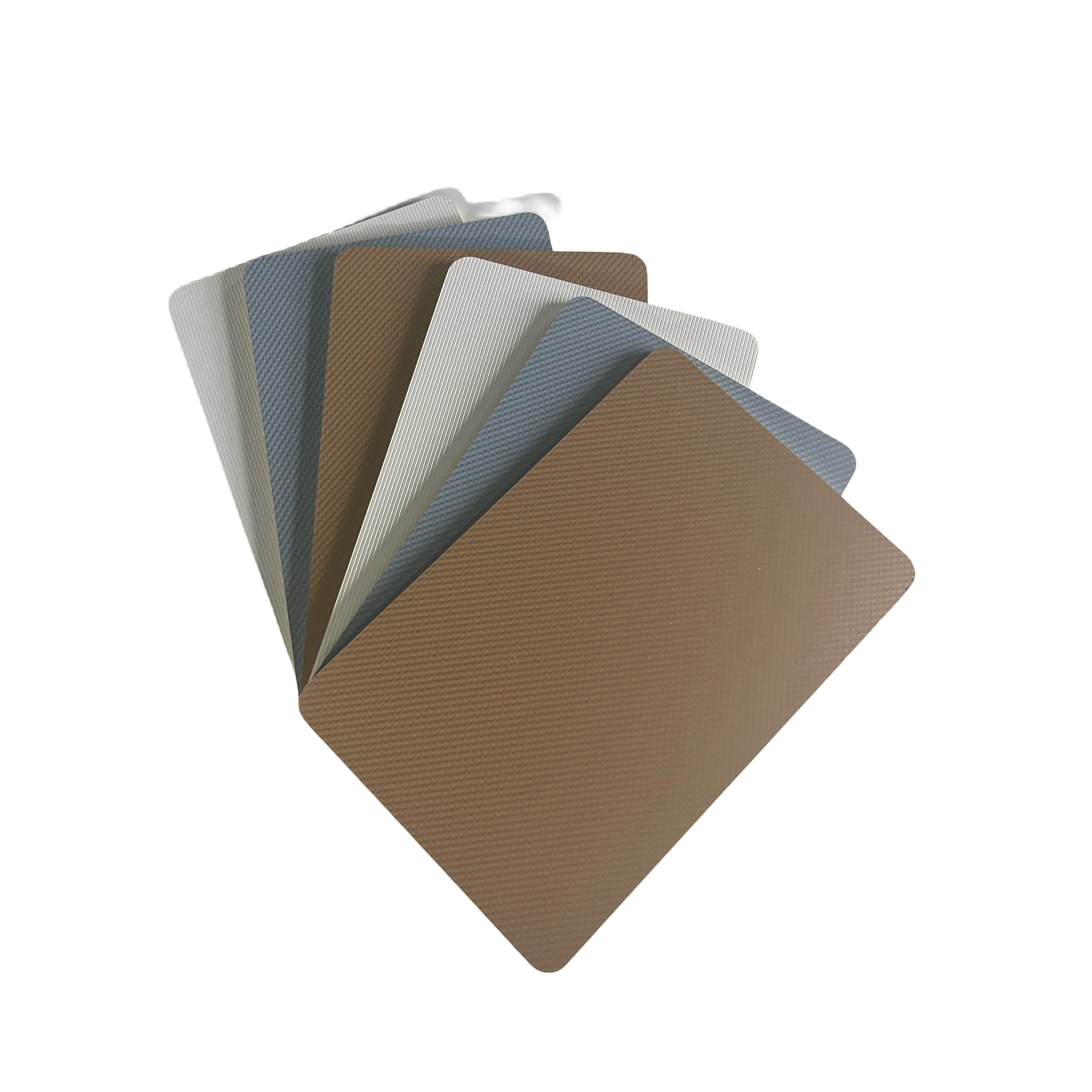
PVC wall panel in a marble pattern, 1220 × 2440 mm format, produced in 5 mm and 8 mm thicknesses.
Why Visual Inspection Fails as a Buying Method
A 5 mm panel and an 8 mm panel share the same face dimensions, the same printed décor and often the same packaging. Held in the hand, both feel rigid. Fixed to a wall and exposed to real conditions, they stop behaving the same way. Visual inspection answers only one question — does the décor look right — and leaves four specification variables unverified:
- Section thickness and profile: a nominally 5 mm or 8 mm panel is a range, not a single figure, and the tolerance band changes stiffness, edge strength and screw or clip holding.
- Core formulation: the ratio of PVC resin to calcium carbonate filler determines weight, toughness, moisture behaviour and how the panel behaves under impact.
- Surface system: a UV-cured or high-gloss coating, a printed film, a hot-stamped or laminated layer each age differently under light and cleaning.
- Installation interface: glue, aluminium profile, hidden fixing or clip systems impose different flatness and substrate requirements on the same panel.
Documented failure patterns for this product family are consistent and largely predictable: surface colour fading and ageing under long-term light exposure, local board deformation in humid and poorly ventilated spaces, splicing gaps and loose joints caused by non-standard keel installation, and surface scratching during construction and daily use. Panels made from recycled or unverified raw material add a further risk that no photograph can reveal.
Decision rule: approve a decorative panel on a three-line specification, not on a sample photo. Line one — thickness and format. Line two — core material and PVC content. Line three — surface treatment and finish. Anything the supplier cannot state in those three lines cannot be verified at arrival.
Industry Background: A Large Market with Tighter Specification Demands
The category being specified here is not a niche. The global PVC panels market reached a valuation of USD 14.8 billion in 2025, and PVC wall panels alone held a 42.5% share of that market by product type, according to Dataintelo. Asia-Pacific accounted for a 38.4% revenue share of the same market. On the material side, the global wood plastic composite market is estimated at USD 8.97 billion in 2025, with a projected CAGR of 11.6% from 2025 to 2030, while synthetic marble products — the segment that includes PVC marble sheets — are projected to grow at a CAGR of 6.8% from 2025 to 2032.
Supply has followed demand. China’s total PVC exports reached an all-time high of approximately 3.82 million tonnes in 2025, a 46% increase over 2024, based on General Administration of Customs of PRC data. For a distributor, the practical consequence is that panel supply is abundant and increasingly similar in appearance, so differentiation shifts to what can be documented: thickness consistency, core composition, surface durability and compliance evidence.
Three standard families frame that documentation. For fire performance, ASTM E84 (UL 723) is the primary interior wall and ceiling finish test in North America, where a Class A rating requires a Flame Spread Index of 0 to 25; in the European Union, EN 13501-1 governs reaction-to-fire classification, and PVC panels for commercial interiors frequently target Class B-s1, d0. For material identity, ASTM D1784 defines cell classification for rigid PVC compounds, with Cell Class 12454 commonly referenced where good impact and tensile strength are required. For durability, ASTM D570 and ISO 62 define water absorption testing of PVC and composite panels, and ISO 105-B02 defines colour fastness to artificial light. These are the reference points a spec-driven buyer should be able to map a supplier’s claim against.
Parameter 1 — Thickness: What 5 mm, 8 mm and 2.5 mm Actually Decide
PVC wall panels: the 5 mm and 8 mm decision
The PVC wall panel range is quoted at 5 mm and 8 mm in two panel formats: 1220 × 2440 mm standard and 1220 × 2800 mm, with model designations YK-1220*2440*5mm, YK-1220*2440*8mm, YK-1220*2800*5mm and YK-1220*2800*8mm. The thickness choice is a rigidity and impact decision more than a price decision.
- 5 mm: the correct specification for flat, protected interior substrates where weight, handling cost and panel volume matter — feature walls, apartment interiors, retail back walls and renovation work where the substrate is already true.
- 8 mm: the specification to select where the wall is exposed to impact, trolley traffic or frequent cleaning, and where long, unsupported spans must stay visually flat. Hotel corridors, restaurant interiors and commercial fit-outs are typical.
- Format pairing: the 1220 × 2800 mm version exists to cover more wall height with fewer horizontal joints; a thicker 8 mm panel is the usual partner for a longer single-panel span because flatness under its own weight improves with section thickness.
Installation method is part of the same decision. These panels are fixed with glue, aluminium profile or hidden fixing, and each method tolerates a different degree of substrate irregularity and panel flexibility.
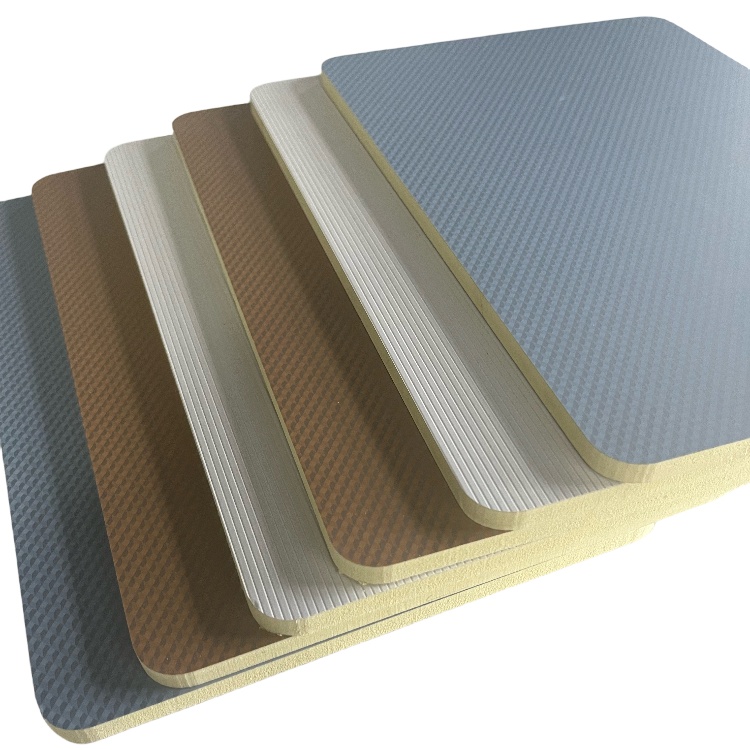
Panel thickness and format should be specified together: 5 mm or 8 mm, 1220 × 2440 mm or 1220 × 2800 mm.
PVC marble sheets: 2.0 mm to 3 mm of bonded cladding
PVC marble sheets and UV marble sheets use a different thickness logic because the panel is bonded to the wall rather than self-supporting. The range is 2.0 mm, 2.2 mm, 2.5 mm, 2.8 mm and 3 mm, in 1220 × 2440 mm standard format and 1220 × 2800 mm oversize, with glue fixing, silicone or aluminium profile installation. Thicker sheets resist transport and site handling damage better, are easier to lay flat over a substrate that is not perfect, and show fewer visible waves under a high-gloss finish. Where a high-gloss coating is specified, chasing thickness reductions is the wrong saving: the surface will reveal every irregularity underneath it.
PVC ceiling panels: 6 mm to 10 mm with a quoted PVC content
Ceiling panels are specified differently again, because the governing dimensions are width and system compatibility before thickness. Widths run from 200 mm to 600 mm, lengths from 2900 mm to 5950 mm, and thicknesses from 6 mm, 7 mm, 7.5 mm, 8 mm, 9 mm to 10 mm, with model designations YK-200*6mm through YK-400*8mm. Crucially, PVC content is quoted as 35% to 50% and is customizable — a figure that should be written into the order rather than assumed. Packaging is available in PE film or carton, with customized options.
Two boundary cases
Interior WPC fluted wall panels use thick profiles rather than thin sheets — models such as 160*20*2900mm, 168*24*2900mm and 200*20*2900mm — because the fluted geometry itself provides rigidity. Outdoor WPC wall panels are thicker again, from 13 mm to 26 mm across widths of 140 mm to 219 mm, because they must resist wind load and temperature cycling outdoors. PVC self-adhesive wall stickers sit at the opposite end at 2.5 mm, sold in 600 mm and 1200 mm widths on 3 m rolls, with an indoor service life of 5 to 10 years.
Parameter 2 — Composition: PVC Resin, Calcium Carbonate and What the Ratio Changes
PVC wall panels, PVC marble sheets and PVC ceiling panels in this family share a common base: PVC resin plus calcium carbonate plus additives. WPC panels replace part of the system with wood fibre. Because the base is simple, the commercial differences are concentrated in the ratio.
- Calcium carbonate is functional, not automatically a defect. It contributes stiffness, dimensional stability and cost control. A higher filler load typically reduces impact toughness, increases panel weight for the same dimensions, and changes how the panel behaves at edges and fixing points.
- PVC content must be stated, not assumed. For PVC ceiling panels the published range is 35% to 50% and customizable. Two suppliers can both quote a 250 × 7.5 mm panel at very different PVC contents, and the samples will look the same.
- Compound identity can be referenced. ASTM D1784 defines cell classification for rigid PVC compounds, with Cell Class 12454 commonly used for building panels where impact and tensile strength are priorities. A supplier who knows their compound data can answer this question; a trading intermediary usually cannot.
- Composite systems change the variables. Interior WPC fluted panels are built from PVC/PE plus wood fibre plus additives and are installed with clips, screws or glue. Outdoor WPC wall panels are built from wood fibre plus HDPE plus additives, in co-extrusion or traditional construction, and are quoted with a service life of 15 to 25 years. Neither should be evaluated against the PVC sheet logic above.
Practical verification: hold two samples of identical panel size and thickness in each hand. A materially heavier panel with the same dimensions usually carries a higher filler load. Then confirm with documentation — declared PVC content for ceiling panels, compound class where available, and water absorption results under ASTM D570 or ISO 62 for panels used in wet or humid areas.
Parameter 3 — Surface Treatment: UV Coating, Gloss Level and Pattern Method
Surface treatment determines how a panel looks after two years, not how it looks on delivery day. It is also the parameter most easily downgraded without changing the visible pattern.
- UV coating and high-gloss coating are the two surface treatments quoted on PVC marble sheets, with surface finishes of high gloss, matte or embossed, and patterns covering marble, wood and golden effects. The coating exists to provide basic anti-scratch performance and to stabilise the surface against light; upgraded anti-scratch surfaces can be requested for engineering projects.
- Printing, hot stamping and lamination are the three surface finishes for PVC ceiling panels. They differ in depth of colour, resistance to cleaning and cost, and should be named explicitly in the order.
- PVC wall panels are offered in marble, wood grain, fabric, stone and metal patterns with a scratch-resistant surface and fire-retardant options. The pattern family should be matched to the application: a high-reflectance marble decoration shows substrate and joint irregularities more readily than a matte wood grain or fabric texture.
- Colour stability claims should be traceable to a test method. ISO 105-B02 covers colour fastness to artificial light, which is the relevant reference when a supplier promises that a decorative surface will not yellow or fade.
Two limits are worth writing into the project file. Standard UV finishes provide basic scratch resistance and should not be exposed to strong friction or hard sharp impact during installation and use. And PVC decorative panels are interior products: long-term outdoor exposure causes surface fading and ageing, so exterior facades belong to a different material family rather than to a thicker PVC sheet.
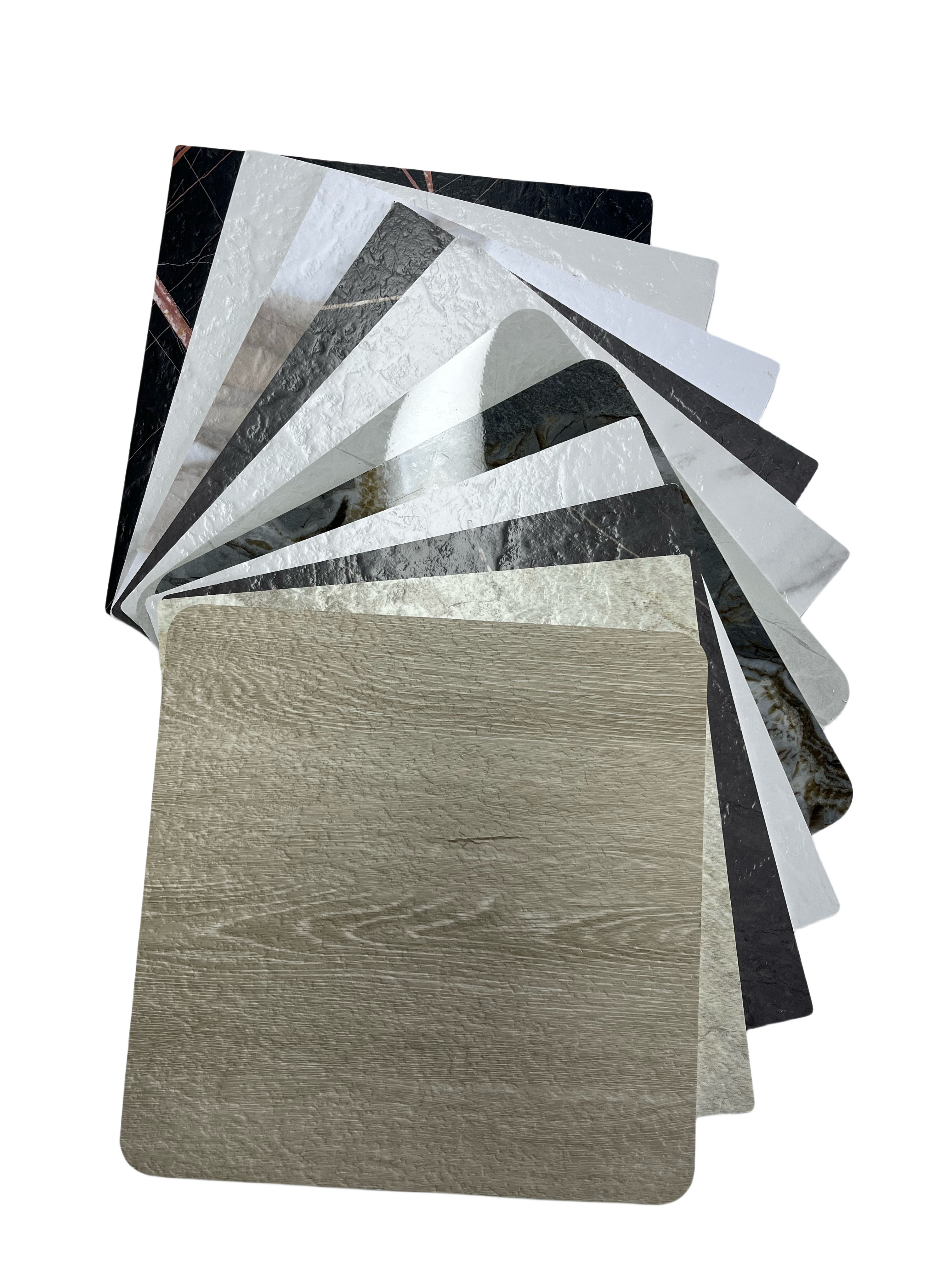
PVC marble sheets are quoted with UV coating or high-gloss coating in high gloss, matte or embossed finishes.
Step-by-Step: A Spec-Driven Selection Workflow
- Define the wall, not the panel. Dry interior, humid interior, high-traffic commercial, or outdoor exposure. This single decision eliminates entire product families: PVC decorative panels for interior walls, outdoor WPC wall panels for exterior facades.
- Lock the product family and model series. For example, PVC wall panel YK-1220*2440*8mm, or PVC marble sheet YK-1220*2440*2.5mm. Model designations prevent a supplier from substituting a neighbouring specification during production.
- Set thickness by span and impact. 5 mm for protected, flat, low-impact walls; 8 mm for impact and long spans; 2.5 mm to 3 mm for bonded marble-sheet cladding where flatness and handling matter.
- Specify core composition. Name the material system (PVC resin plus calcium carbonate plus additives) and, for ceiling panels, state the required PVC content within the published 35% to 50% band.
- Specify surface treatment and finish. UV coating or high-gloss coating; high gloss, matte or embossed; printing, hot stamping or lamination for ceiling panels. Add fire-retardant options where the project requires them.
- Align compliance evidence with the destination market. ASTM E84 Class A framing for North America, EN 13501-1 classification for the EU, and the relevant water absorption and light fastness test methods where those properties are being promised.
- Match installation method and accessories. Glue, aluminium profile or hidden fixing for PVC wall panels; glue, silicone or aluminium profile for marble sheets; clip, screw or glue for interior WPC; keel frames with fixed accessories and corner trims for ceiling systems.
- Validate on a production-thickness sample and fix batch controls in the order. A sample in the ordered thickness, core and finish, supported by test reports and pre-shipment inspection, converts a specification into a repeatable supply line.
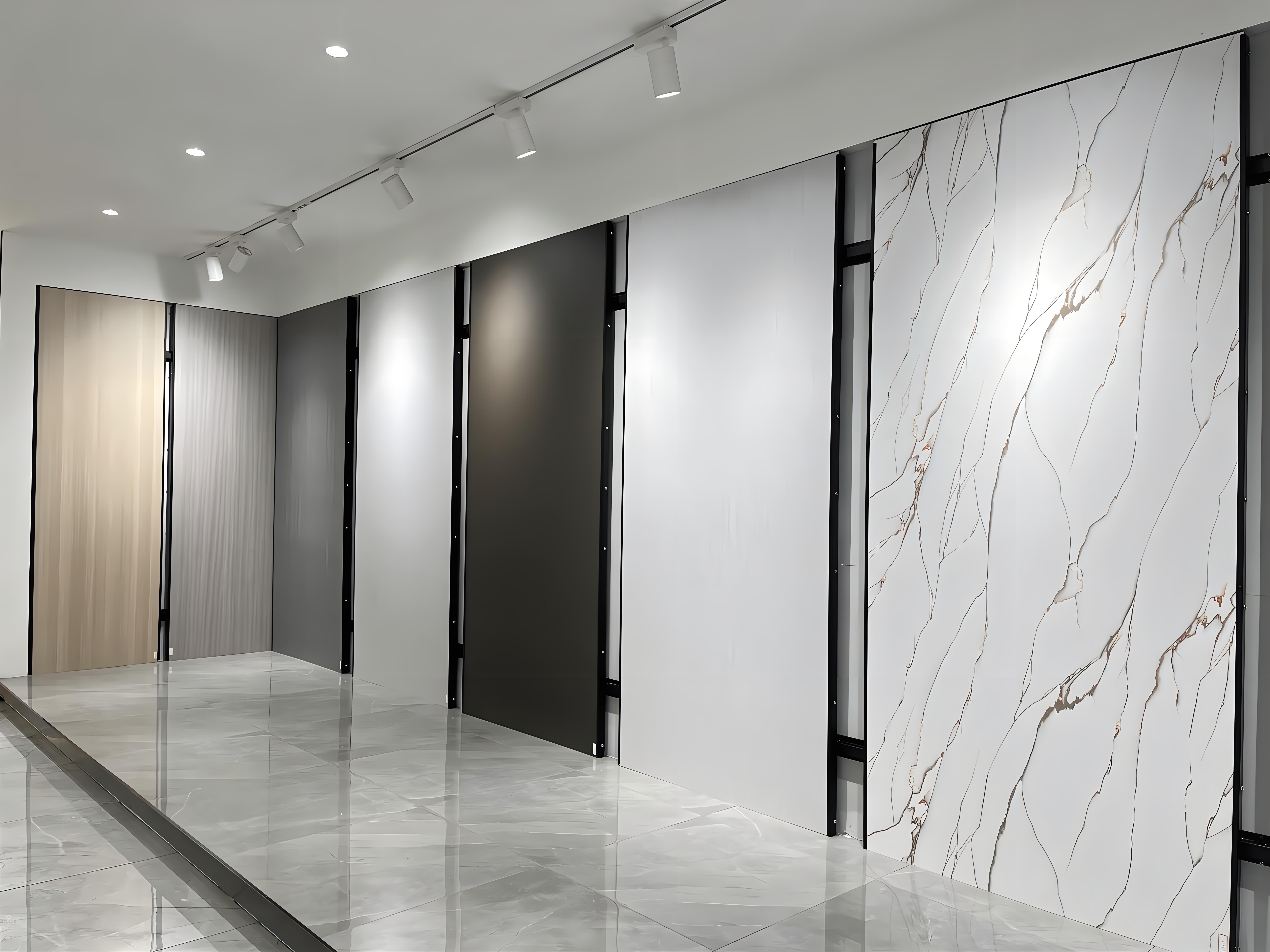
Installation method belongs in the specification: keel or glue fixing, connectors and trims must match the panel thickness and format.
Use Cases: Matching Thickness and Core to Real Projects
The specification logic above is not theoretical. YIKE NEW MATERIAL operates a 10,000 m² factory with 50 employees, an annual output of 5,000,000 m² and a monthly capacity of 500,000 m², supported by a 10-engineer R&D team, and exports 100% of its production to Central America, South America, Southeast Asia, the Middle East and Africa. The following applications show how thickness, core and surface choices map onto real project conditions.
- Retail and brand stores — Ecuador. A building materials distributor has taken 3 × 40HQ containers over a two-year relationship, applying PVC ceiling panels for clean ceiling lines, PVC marble sheets for feature walls and WPC wall panels for durable interior finishes in retail shops, brand stores, showrooms, offices and restaurants.
- Residential renovation — El Salvador. A 1 × 40HQ container supply over three years focused on home interiors, where PVC ceiling panels, PVC marble sheets and WPC wall panels combine to deliver affordable, durable decoration.
- Volume distribution — Colombia. More than 60 × 40HQ containers per year of PVC ceiling panels, PVC marble sheets and WPC wall panels, supplied as a complete decorative material range rather than single-item replenishment.
- Tropical climate performance — Malaysia. Decorative panels installed in over 100 residential houses, with continued selection for new renovation projects, which is the practical test of moisture behaviour for interior panels in humid conditions.
- Renovation service provider — Indonesia. 10 × 40HQ containers over three years of continuous supply of PVC ceiling panels, PVC marble sheets and WPC wall panels for residential and commercial interior projects.
- Wet-area interiors. PVC marble sheets are quoted as 100% waterproof and are used in bathrooms, kitchens and other humid indoor areas; continuous soaking is avoided at installation and the substrate must be flat for glue bonding.
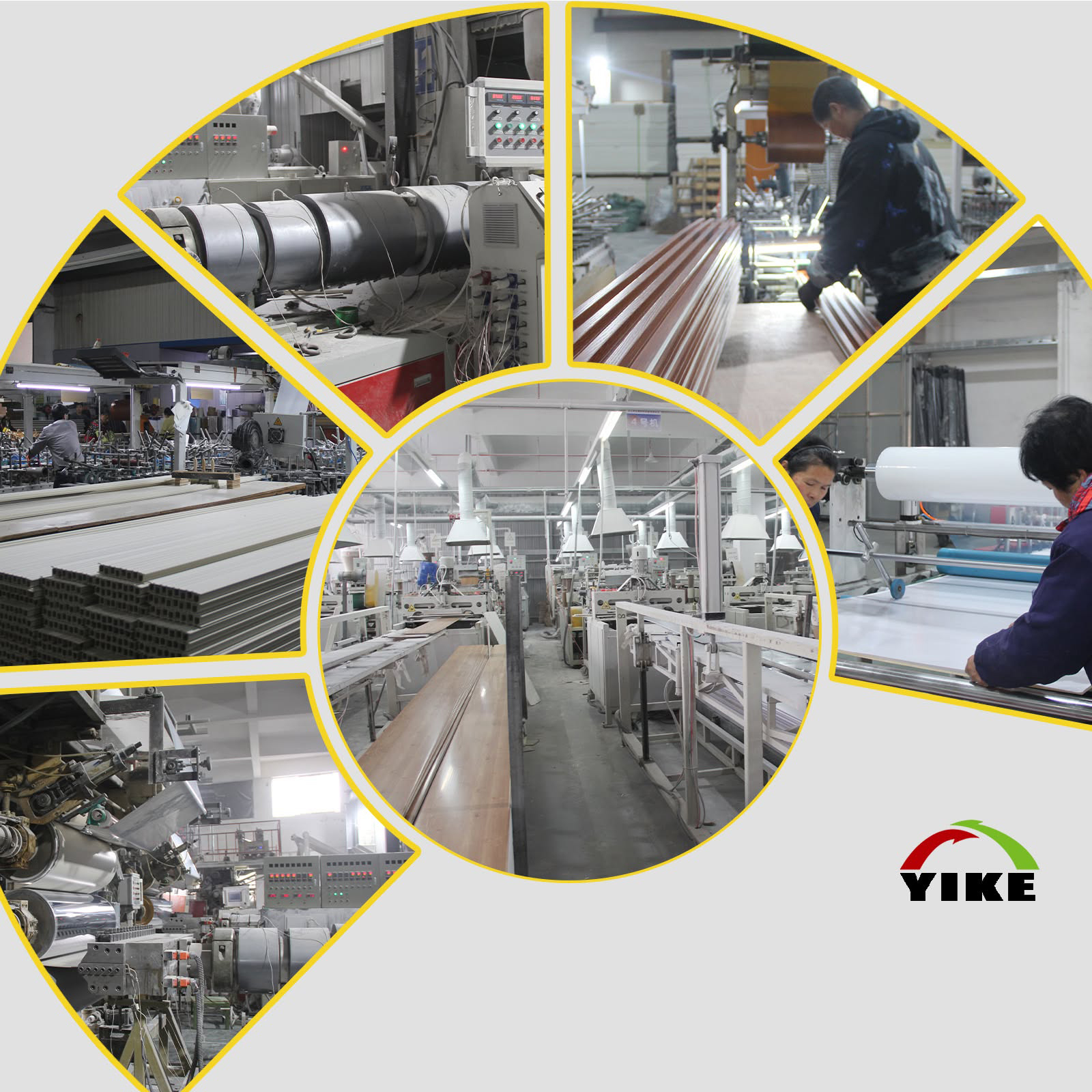
YIKE NEW MATERIAL produces PVC and WPC decorative panels at its 10,000 m² manufacturing base in Haining, Zhejiang.
Comparison Table: Decorative Panel Families by Specification
| Panel family | Core material | Format and thickness | Surface | Installation | Primary application |
|---|---|---|---|---|---|
| PVC Wall Panel (YK-1220*2440 / 1220*2800) | PVC + calcium carbonate + additives | 1220 × 2440 mm standard; 1220 × 2800 mm; 5 mm and 8 mm, customized | Marble, wood grain, fabric, stone, metal patterns; scratch-resistant surface; fire-retardant options | Glue, aluminium profile, hidden fixing | Interior wall decoration in residential, hotel, office and retail interiors |
| PVC Marble Sheet / UV Marble Sheet | PVC resin + calcium carbonate + additives | 1220 × 2440 mm standard; 1220 × 2800 mm; 2.0 / 2.2 / 2.5 / 2.8 / 3 mm | UV coating or high-gloss coating; high gloss, matte, embossed; marble, wood, golden patterns | Glue fixing, silicone, aluminium profile | Interior feature walls, bathrooms and kitchens; quoted as 100% waterproof |
| PVC Ceiling Panel | PVC resin + calcium carbonate + additives; PVC content 35%–50% (customized) | Widths 200–600 mm; lengths 2900–5950 mm; 6 / 7 / 7.5 / 8 / 9 / 10 mm | Printing, hot stamping, laminated | Keel frame, fixed accessories, corner lines | Interior ceilings including humid rooms; PE film or carton packaging |
| Interior WPC Fluted Wall Panel | PVC/PE + wood fibre + additives | 2900 mm length profiles, e.g. 160 × 20 mm, 168 × 24 mm, 200 × 20 mm | Realistic wood texture; walnut, oak, teak, black, grey, natural wood, customized | Clip, screw fixing, glue | Interior walls, TV backgrounds, hotel and office interiors |
| Outdoor WPC Wall Panel | Wood fibre + HDPE + additives; co-extrusion or traditional | 2900 mm length; widths 140 / 145 / 177 / 219 mm; 13 / 20 / 26 mm | Wood grain, brushed, sanded, embossed, 3D wood texture | Anti-rust keel, stainless fasteners, expansion gaps | Exterior facades and landscaping; quoted service life 15–25 years |
| PVC Self-Adhesive Wall Sticker | PVC | Widths 600 / 1200 mm; 3 m roll length; 2.5 mm | Glossy, matte, embossed; marble, wood, stone, brick, tile, floral patterns | Peel-and-stick self-adhesive | DIY and renovation of flat, dry interior walls; indoor service life 5–10 years |
Frequently Asked Questions
What compliance documents should EU distributors request for PVC decorative panels?
For the European Union, EN 13501-1 is the reference standard for reaction-to-fire classification of construction products, and PVC panels for commercial interiors frequently target Class B-s1, d0. In North America the equivalent reference is ASTM E84 (UL 723), where a Class A rating corresponds to a Flame Spread Index from 0 to 25. Distributors should request the classification or performance documentation for the exact panel build being ordered — thickness, core and surface — because a certificate issued for a different build does not transfer. Where moisture performance matters, ASTM D570 and ISO 62 are the standard water absorption test methods, and ISO 105-B02 covers colour fastness to artificial light. YIKE supports orders with 100% pre-shipment testing and third-party inspection (SGS); project-specific compliance documents should be confirmed for the exact model and destination market before the order is placed.
How can a buyer verify the core composition of a PVC wall panel before ordering?
Ask for the declared formulation and PVC content, then verify by weight and by test. PVC wall panels, PVC marble sheets and PVC ceiling panels are built from PVC resin, calcium carbonate and additives; PVC ceiling panels are quoted at a PVC content of 35% to 50% and customizable, which means the buyer must state the figure in the specification rather than assume it. A higher calcium carbonate share lowers resin cost and raises stiffness, but usually reduces impact toughness and increases weight for identical dimensions. Rigid PVC compounds are commonly referenced against ASTM D1784, with Cell Class 12454 used where good impact and tensile strength are required. Water absorption can be verified under ASTM D570 or ISO 62. Comparing the mass of two samples of identical size and thickness is the fastest first check.
Which parameters drive the price of PVC wall panels and PVC marble sheets?
Four specification choices set the cost: core composition (PVC content and filler load), thickness (5 mm versus 8 mm for wall panels; 2.0 mm to 3 mm for marble sheets), panel format (1220 × 2440 mm standard or 1220 × 2800 mm oversize) and surface treatment (UV coating, high-gloss coating, printing, hot stamping or lamination). Order structure matters as well. YIKE’s standard minimum order quantity is one 20-foot container with 4 to 6 colours from the e-catalogue; below that level, buyers can order 500 sqm per colour from stock colours, or 1000 sqm per colour from the e-catalogue. Quotations are only comparable when all four specification variables are stated identically on both sides.
Can thickness and composition be validated with a pre-production sample?
Yes, and it is the lowest-cost risk control available to a buyer. Request a sample in the exact thickness and core that will be produced — a 5 mm display sample does not validate an 8 mm order. On receipt, check section thickness, panel flatness, surface adhesion, edge quality and colour against the agreed reference. YIKE provides pre-production samples and test reports, and confirms sample quality before bulk production, which is the point at which specification errors are still cheap to correct.
What lead time, capacity and supply terms should buyers plan for?
Production lead time for YIKE decorative panels is 14 to 30 days, supported by a monthly capacity of 500,000 m² and an annual output of 5,000,000 m². Quality control covers 100% pre-shipment testing and third-party inspection (SGS), and after-sales support is provided as remote technical support. Buyers ready to move from specification to decision can download the YIKE New Material catalogue at the 2026 catalogue download and send the target panel family, thickness and destination market for a sample or quotation.
Conclusion: Specify Three Lines, Not One Photograph
Decorative panel selection becomes predictable once thickness, core composition and surface treatment are treated as the specification rather than as assumptions. A 5 mm PVC wall panel and an 8 mm PVC wall panel are not interchangeable, a 2.5 mm PVC marble sheet and a 3 mm sheet are not interchangeable, and a quoted PVC content of 35% and 50% describes two different products even when the décor film is identical. The verification path is equally clear: named model designations, declared material systems, thickness and format tolerances, surface treatment named in full, and compliance evidence mapped to the relevant standard for the destination market — EN 13501-1 or ASTM E84 for fire performance, ASTM D570 or ISO 62 for water absorption, ISO 105-B02 for light fastness, ASTM D1784 for rigid PVC compound classification.
Haining Yike New Material Co., Ltd. is a China-based manufacturer and exporter of PVC ceiling panels, PVC wall panels, PVC marble sheets, UV marble sheets, WPC wall panels, outdoor WPC wall panels, PVC decorative panels and PVC self-adhesive wall stickers, supplying distributors, wholesalers, contractors and retailers across Central America, South America, Southeast Asia, the Middle East and Africa, with OEM and ODM customization of colour, pattern and logo.
Next Step: Sample, Quotation or Catalogue
Send the panel family, thickness and format you intend to specify — for example PVC wall panel YK-1220*2440*8mm or PVC marble sheet YK-1220*2440*2.5mm — and YIKE can respond with matching samples, technical data and a quotation for your market.
- Catalogue download: (2026) YIKE New Material PDF catalogue
- Website: www.merchandise-eco.com
- Email: sales@merchandise-eco.com
- Tel / WhatsApp: +86 188-5830-7787
- Address: Room 1315, NO. 273 Haining Avenue, Haizhou Street, Haining, Jiaxing City, Zhejiang Province, China
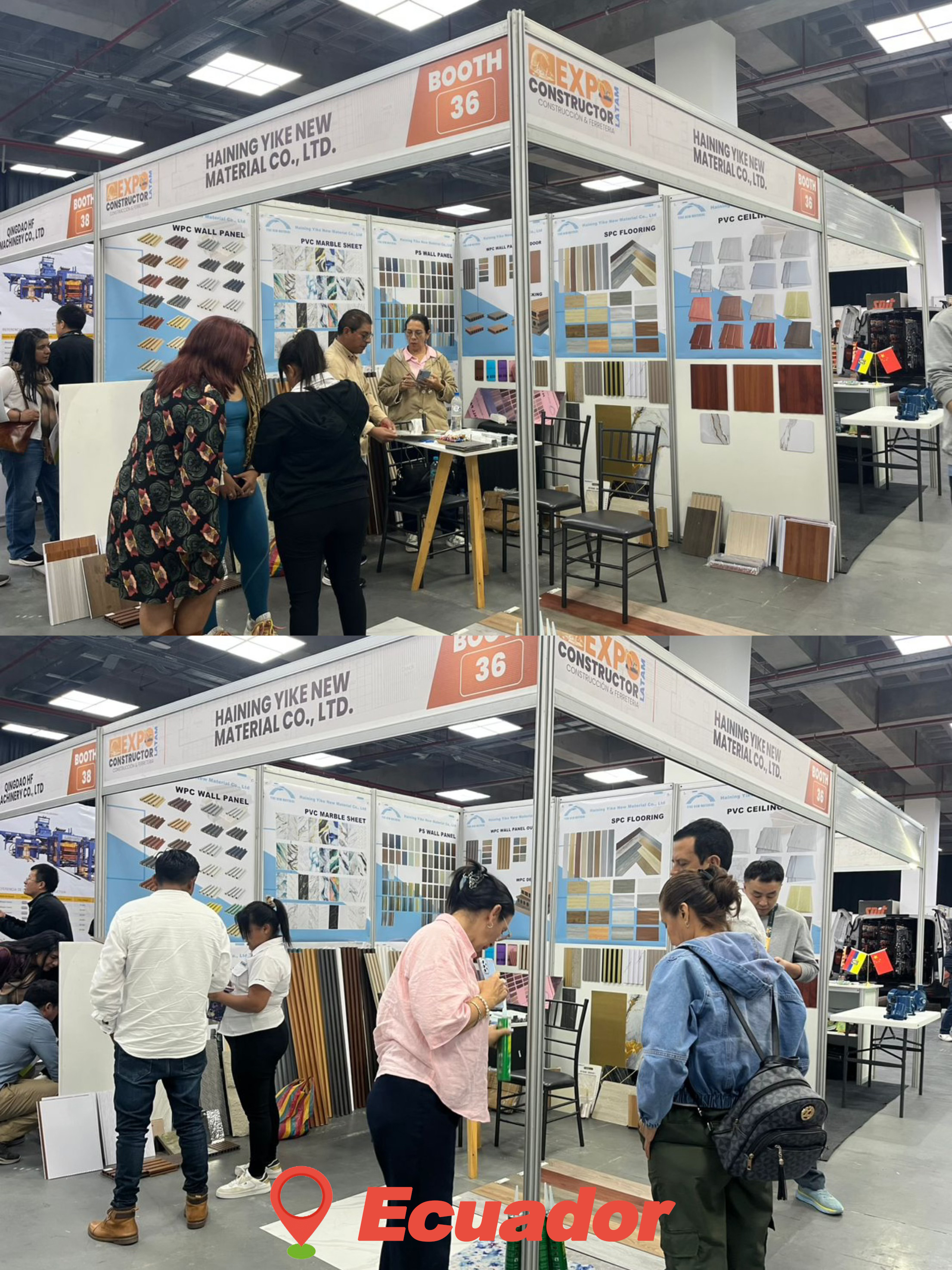
YIKE NEW MATERIAL presenting PVC and WPC decorative panel systems to overseas buyers at the Ecuador Quito trade fair.
Have Questions or Need More Details?
Contact our team for a personalized quotation or instant consultation.
Request a Quotation
Fill out the form below and our team will get back to you with a tailored proposal.
WhatsApp Direct Chat
Prefer to chat in real-time? Message us on WhatsApp for instant assistance & quick answers.
- Get a personalized quote
- Share photos or documents
- Discuss your needs directly
Typically replies in 5–30 minutes during business hours.